
Not long ago, such a scenario would have seemed impossible. Geopolitical tension is rising in the world, the Middle East is once again on the brink of escalation, and Israel is striking South Pars – the largest known gas field in the world, shared by Iran and Qatar.
This is an event that, in classic terms, should immediately trigger a panic movement of capital towards “safe havens”. And yet gold does not react the way investors have been accustomed to for decades.
Instead of dynamic growth, we see something completely different. The bullion rate has retreated and is stabilizing today around USD 4,500. In the context of geopolitical tensions, this is an unusual situation, to say the least. In previous cycles, similar events led to sharp price rallies. Today the market is behaving as if… not surprised.
Does this mean that gold is losing its role? Or maybe we are dealing with a more complex mechanism that is just getting started?
Why isn’t gold rising despite the conflict?
Financial markets rarely react linearly. What looks like a lack of reaction today is often the result of previous “discounting” of risk.
And this is one of the key pieces of the current puzzle. Gold has been close to historical highs in recent months, which is why some investors were already prepared for the stress scenario and did not need an additional impulse to buy even higher.
The second element is classic profit taking. In moments of uncertainty, paradoxically, not everyone buys – part of the market closes positions, hedging earlier increases. This is a mechanism often overlooked in simplified narratives about “escape to gold”.
The third, and perhaps most important, factor is the strength of the US dollar. In a world where capital seeks security, the dollar remains one of the main beneficiaries. Today, capital is divided between various assets, which naturally blurs the scale of movements that seemed obvious until recently.
The market is in the “checking” phase
As Jakub Bartoszek, president of Cashify Gold, notes:
The market is at a specific moment today. On the one hand, we have geopolitical tensions that have historically always supported gold, but on the other, some of this risk has already been priced in. Three scenarios are key now. If the conflict remains local, gold may continue to move sideways, especially with a strong dollar. However, if energy prices escalate and increase, which translates into inflation, gold has room to move upwards again – potentially with a delay. The third scenario is a further strengthening of the dollar, which may limit the metals’ growth potential in the short term, even with increased geopolitical risk. Currently, the market is testing which of these directions will prove dominant
Bitcoin comes into play
At the same time, something is happening that the market would not have taken into account just a few years ago.
The world’s largest cryptocurrency remains around $70,000, showing surprising resilience to the current turbulence. And although its volatility is still incomparably higher than in the case of gold, it can no longer be ignored that for some investors it has become a real alternative.
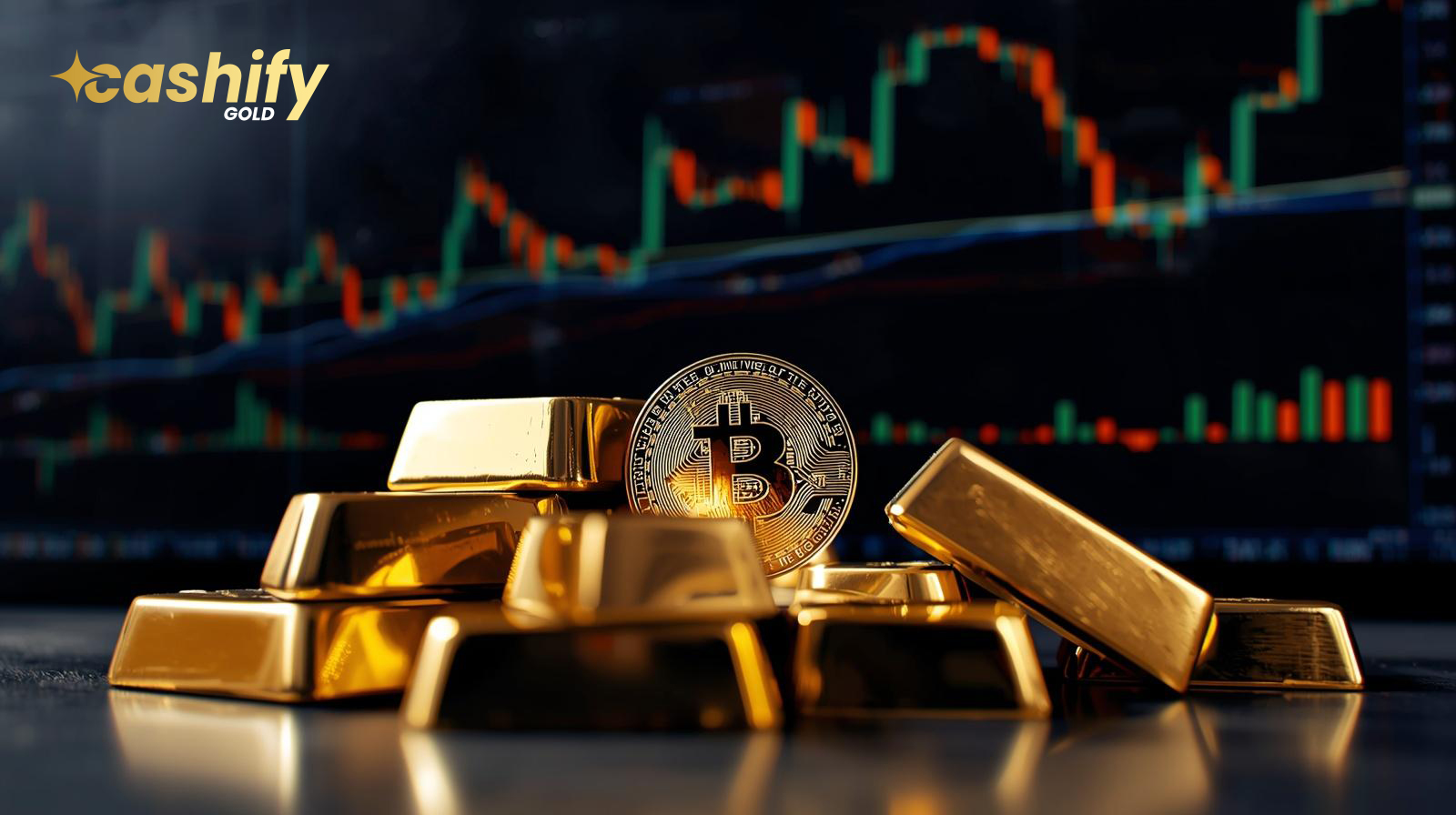
The narrative of “digital gold” suddenly ceased to be just a marketing slogan. Bitcoin offers something that traditional assets do not: independence from the financial system, limited supply and global availability without intermediaries.
Does this mean that Bitcoin is taking over the role of gold? Not necessarily. It is more likely that we are observing a process of coexistence of two orders. On the one hand, we have digital assets – fast, liquid and global. On the other hand, precious metals are physical, independent of technological infrastructure and rooted in the financial system for thousands of years.
Gold and silver still play a strategic role. Central banks not only do not abandon the precious metal, but even increase its share in reserves. The National Bank of Poland is one of the examples here – it is consistently building its resources, treating gold as the foundation of security.
The situation is similar in the case of silver, whose importance increases with the energy transformation. Demand from industry, especially the renewable energy sector, remains high.

Is this the silence before the movement?
The current situation shows a change in investor behavior rather than a lack of market reaction. Instead of one dominant direction, we increasingly see the dispersion of capital between different asset classes – from the dollar, through gold, to cryptocurrencies.
This approach is especially visible in diversification strategies. More and more market participants no longer focus on one scenario, but build exposure to several possible variants of the situation at the same time.
In practice, this means combining digital assets with physical precious metals not as an alternative, but as a complement.
The market is looking for a new balance
The lack of a strong reaction of gold to events that, until recently, automatically triggered increases, shows that investors act differently today – faster, more selectively and with greater consideration of many parallel factors.
A single impulse, even one as strong as a geopolitical conflict, is no longer enough to dominate market direction.
Gold is not disappearing from the game, but it is no longer the only obvious “safe haven”. Bitcoin and the dollar are actually competing for the same capital today, which changes the dynamics of flows and makes market reactions more spread over time.
In practice, this means that the advantage is gained not by those who look for simple relationships, but by those who can function in an environment where several scenarios can be realized simultaneously – and the market direction no longer results from one event, but from their combination.
