
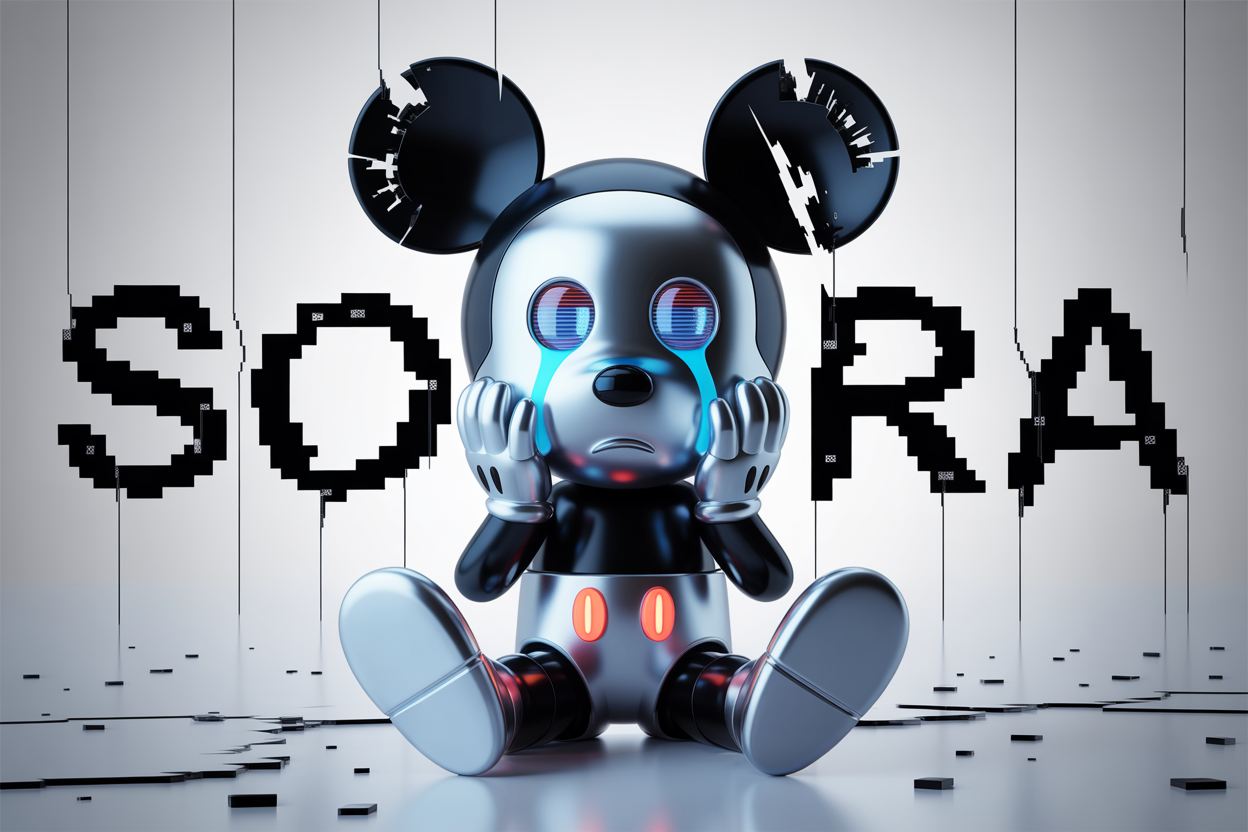
For a while it looked like a breakthrough. OpenAI introduced Sora to the world at the end of 2024, and for a few weeks everyone was talking about the fact that AI had just learned how to make movies. And now? Sora is dead, the deal with Disney is in ruins, and the entire industry is pretending this is a planned “strategic pivot.” Is this the beginning of the bursting AI bubble?
Why does Sora have to disappear?
A fundamental and key question arises here – did the people responsible for the “Mickey Mouse” deal know during the negotiations that the project was heading for failure? Or was this information kept top secret?
OpenAI’s financial abyss
And here we come to the point that the industry media likes to keep silent: OpenAI still does not bring real profits. The company with a valuation reaching hundreds of billions of dollars (already over USD 500 billion) remains a de facto start-up burning cash at a rate that is increasingly worrying analysts.
The costs of computing infrastructure, salaries of leading researchers and aggressive product expansion mean that the gap between revenues and expenses is not narrowing at all. Some analysts already point to 2028 as the key “deadline”. If by this time the company does not achieve sustainable profitability or does not successfully enter the stock exchange, the scenario of serious problems becomes real.
Husson directly suggests that the decision to close Sora could have been dictated by the desire to “minimize risk” against potential bankruptcy.
Bubble burst or healthy reset?
The closure of Sora and the breakdown of the deal with Disney are not random events, but a signal worth reading carefully. Sora was OpenAI’s flagship PR project: proof that the company was not just “the ChatGPT guy” but a pioneer of multimodal generative AI. The contract with Disney was supposed to be a breakthrough for the relationship between Hollywood and Silicon Valley. Both of these symbols collapsed within a few weeks.
Does this mean the AI bubble has burst? Not necessarily all of it, but it is very possible that a specific, overestimated layer is cracked. Video generation has proven to be more difficult to commercialize than expected, and growing competition from Chinese platforms such as Seedance, Hailuo, and Kling only worsens the situation. Investors are starting to ask uncomfortable questions about when “artificial intelligence” will start bringing “real profits.”
OpenAI is not going bankrupt, but it is clearly no longer pretending that everything is going according to plan. And this, paradoxically, may be the first step towards something more sustainable. The only question is whether the market and investors have enough patience to wait for it.