
Today, May 1, 2026, Cathie Wood published the annual Big Ideas report – and its conclusions about Bitcoin are so bold that it is hard to ignore them. ARK Invest predicts that BTC capitalization will increase to $16 trillion by 2030. For comparison: today it is about 1.5 trillion. This is a more than 10-fold increase in four years – and this is not fortune telling, but a model based on six specific pillars of demand. We check which of them are reliable and where ARK may be wrong.
Where did 16 trillion come from?
ARK Invest is not an ordinary fund. It’s the largest active ETF investing in future technologies, managed by Cathie Wood – the person who bet on Tesla when everyone laughed and on Bitcoin when institutions looked away. Its annual Big Ideas report is one of the most important documents in the innovation investment industry. This year’s edition was released today and contains a forecast that circulated in the global financial media within hours.
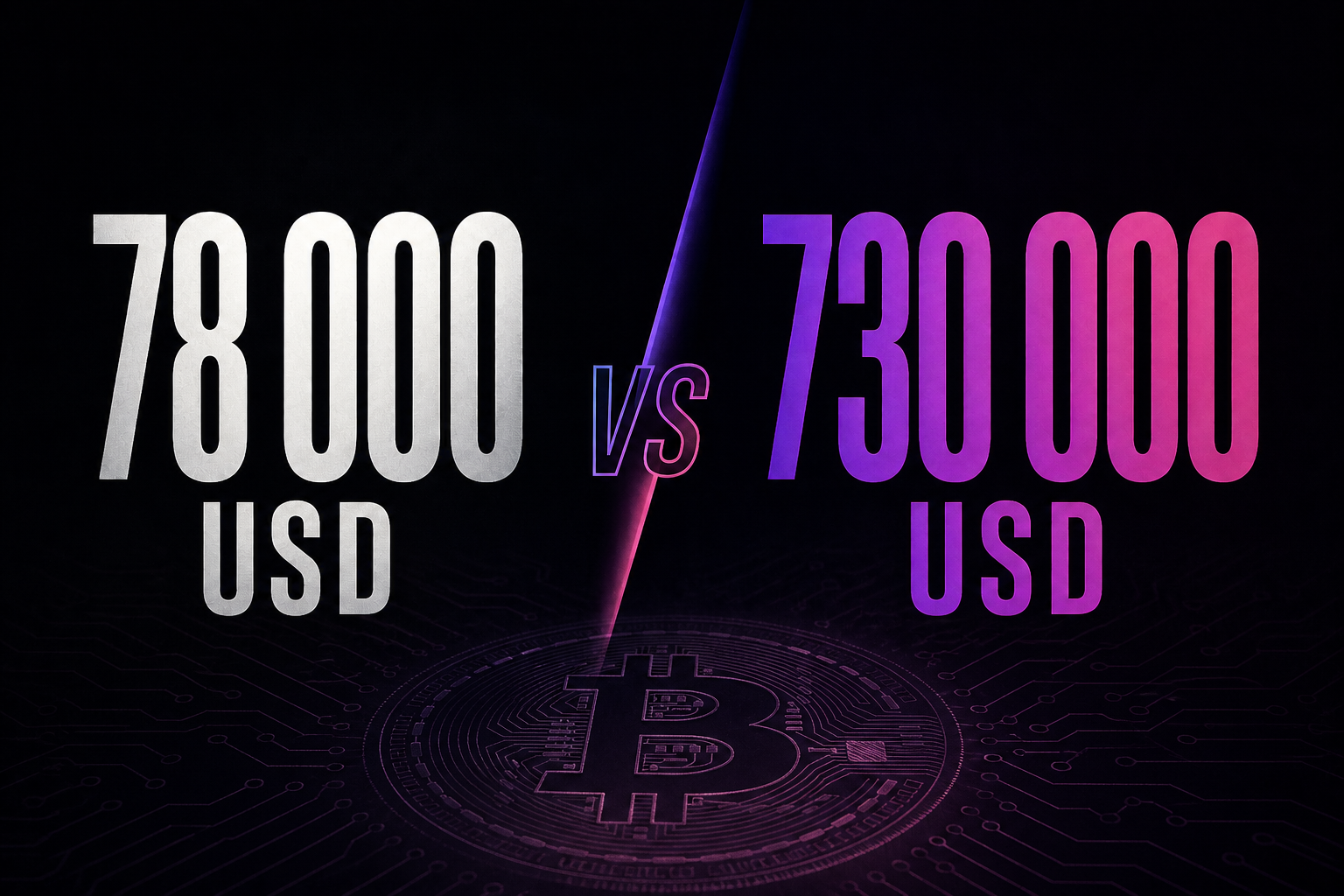
The number is specific: ARK forecasts Bitcoin’s capitalization to increase to $16 trillion by 2030 – a more than 10-fold increase from the current approximately $1.5 trillion. With today’s BTC supply, this would mean a price of around $730,000 for one coin. In a bullish scenario, ARK is talking about as much as $1.5 million per BTC.
But here’s the rub: ARK doesn’t just throw a number out of a hat. The forecast is based on six separate demand pillars. Let’s take a look at each of them – because this is the only way to assess how much of this forecast is sober analysis and how much is wishful thinking.
Six pillars – and what really stands behind them
Pillar 1: Bitcoin as digital gold – and the strongest one at that
This is the largest component of the entire forecast. ARK estimates that Bitcoin could capture about 40 percent of the gold market’s value – and with gold growing 64.5 percent in 2025, the total addressable market for “digital gold” has grown to $24.4 trillion. From this pillar alone, ARK derives a base contribution of USD 9.8 trillion to the BTC capitalization.
This is strong logic. Gold is held by central banks, funds and wealthy investors mainly because it is politically neutral and resistant to inflation. Bitcoin has the same properties – only it is 10 times more portable, auditable in real time and resistant to confiscation. If even some institutions switch from physical gold to BTC, the capital is astronomical.
Pillar 2: Institutions and ETFs – already happening
U.S. bitcoin ETFs and listed companies now collectively hold 12 percent of the total BTC supply – up from 8.7 percent a year ago. This is not a forecast – it is a fact that you can check on-chain. BlackRock, Fidelity, Canadian pension funds – institutions are quietly accumulating. ARK estimates that even a modest allocation of 2.5 percent of a global $200 trillion investment portfolio would give Bitcoin an additional $5 trillion in capitalization.
For the Polish investor: if funds managing pension money in Canada, Norway or Texas already have BTC in their portfolio – and you do not – it is worth asking yourself what they see that you do not see yet.
Pillar 3: State treasuries – a niche but real scenario
The US has built a strategic bitcoin reserve. ARK assumes that other countries will follow this path. This is currently the least reliable pillar – because it requires political decisions that are difficult to predict. Poland or EU countries are unlikely to follow this path in the next four years.
Pillar 4: Corporate treasuries – the Strategy model is spreading
Strategy (formerly MicroStrategy) proved that a listed company can build shareholder value by accumulating BTC. Copycats are multiplying. This pillar is solid – because the motivation here is simple: shareholders reward companies that hold BTC with higher valuations.
Pillar 5: Emerging markets as a refuge – this is where ARK changes its mind
That’s an interesting twist. ARK has severely limited its assumptions in this pillar. The company reduced its demand estimates from emerging markets by 80 percent – largely because stablecoins are displacing Bitcoin as an inflation protection tool in developing countries. An Argentinian or Nigerian who is looking for an escape from a weakening currency today reaches for the dollar in the form of USDT – not BTC. This is an honest correction and proof that the ARK report is not propaganda, but real analysis.
Pillar 6: Financial services on Bitcoin – Lightning and Layer 2
Lightning Network, wrapped Bitcoin, payment network – Bitcoin as a financial infrastructure, not just a reserve of value. This pillar is the least advanced today, but the most groundbreaking in the next decade.
What needs to happen for this prediction to come true?
Honest answer: a lot. ARK simultaneously assumes: no serious regulatory attacks on BTC in the US and Europe, continued institutional adoption, geopolitical stability sufficient to maintain risk appetite, and no technological breakthrough (e.g. quantum computers) that would undermine Bitcoin cryptography.
None of these conditions are guaranteed. Which means the $730,000 forecast is more of a map of possibilities than a promise. ARK analyst David Puell summed it up soberly: “The composition of demand is evolving, but the long-term thesis remains intact.”
What does this mean for the Polish investor – today, at $78,000?
Two perspectives, both honest.
Optimistic outlook: If even half of the ARK scenario comes true – BTC at $350,000-400,000 in 2030 – then every percentage of the portfolio invested today at $78,000 will give a five-fold return. With the classic allocation of 3-5 percent to “alternatives”, this is an asymmetric bet: limited risk, huge potential.
Skeptical perspective: ARK is a fund that has an incentive to be bullish on Bitcoin – it holds BTC itself and sells ETFs that expose crypto. ARK’s previous forecast assumed BTC at $500,000 by the end of 2026 – we are at 78,000. The accuracy of Cathie Wood’s point forecasts is sometimes questionable.
Our conclusion: The ARK report is valuable not as an oracle, but as a map – it shows where demand may come from and what conditions must be met. For a wealthy investor looking for diversification, this is a strong argument for not having zero in BTC. I’m not in favor of going all-in.