
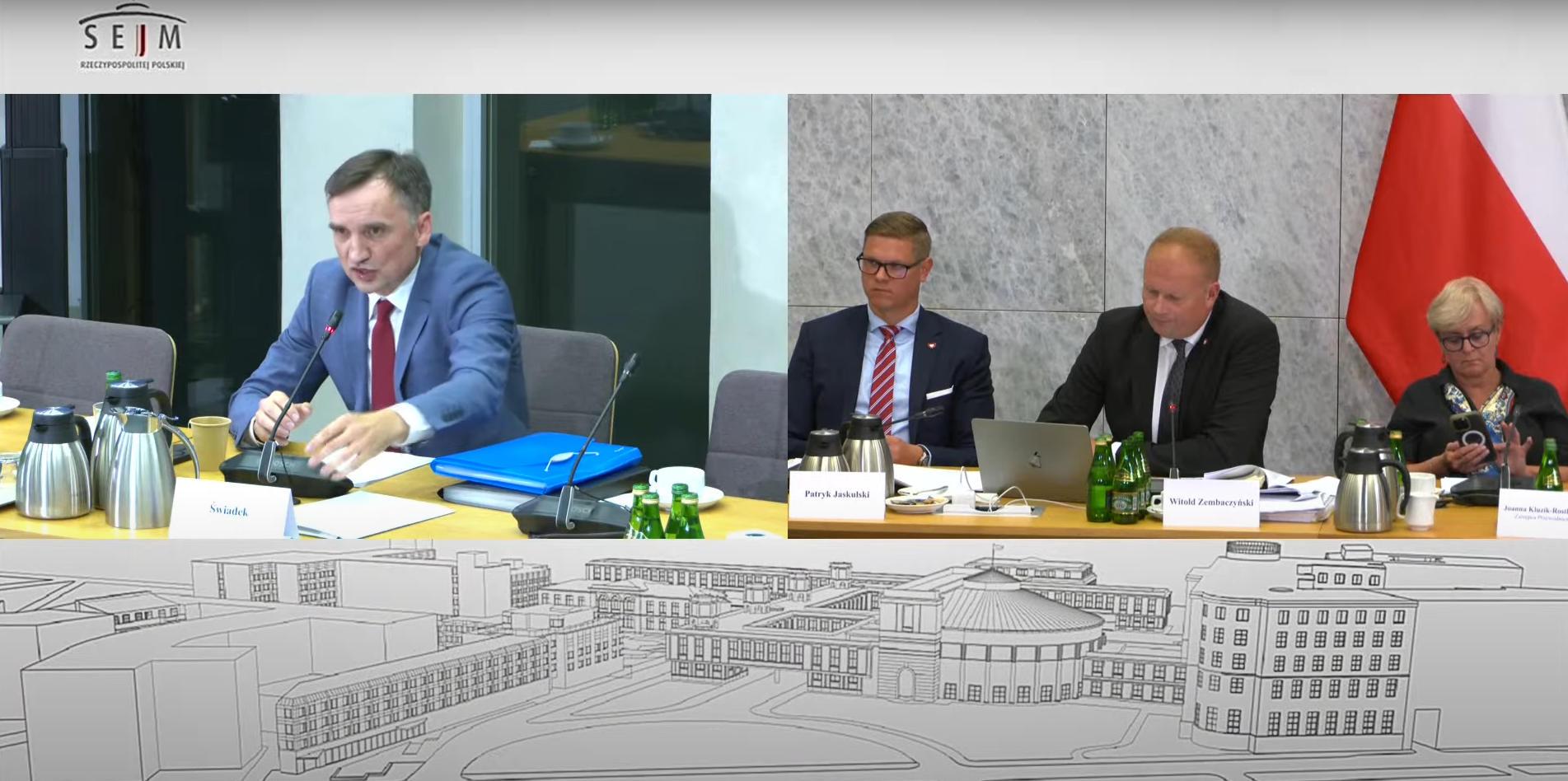
Monday at Wiejska promised to be like the next day of the political theater, but the reality exceeded the script. Zbigniew Ziobro (former Minister of Justice and Prosecutor General) for the ninth time was summoned before the Sejm Investigative Commission for Pegasus. This time it did not end up in the invitation.
Around 10.30 his plane landed in Warsaw, and police officers were already waiting on the airport. The former head of the Ministry of Justice was led out and brought straight to the Sejm, where the long -awaited committee meeting began at noon.
Pegasus – a spy that leaves no traces
As a reminder: Pegasus is an Israeli surveillance system of a military class, allowing you to take control of the smartphone fully – from reading messages, through eavesdropping conversations, to turning on the camera and microphone. In Poland, it became a symbol of political wiretaps on steroids, used not to fight terrorism, but towards political opponents.
The most bright case is the case of Krzysztof Brejza. According to the findings of the Canadian Citizen Lab, his phone was hacked 33 times between April and October 2019 – just when he was the chief of staff of the KO in the election campaign. As Brejza revealed, the services have drawn 85,000 messages from his phone from the last ten years.
I was under surveillance for half a year in two election campaigns. The operation of the services ended with nothing – I have never heard the allegations
– he said in RMF FM in 2024. His wife Dorota added: “The story of Pegasus is a story of great harm, we have been destroyed for years.”
Ziobro versus Commission
Zbigniew Ziobro, interrogated on Monday, tried to present the matter of Brejzy as an element of “broader behavior”.
To my knowledge, the proceedings were initiated to explain whether the leak really came from Pegasus or from another source
– said the former Minister of Justice.
He added that he learned about surveillance with a delay, but he became acquainted with the request to repeal Brejza’s immunity and found evidence “convincing”.
In the same speech, the former minister threw another strong thesis.
Russian services participated in the disclosure that, among others Poland uses a tool, which is Pegasus
Ziobro said, suggesting that the Kremlin had an interest in publicizing the scandal.
Ziobra’s words immediately caused the reaction of the person concerned.
I am asking to confront Zbigniew Ziobro to the inquiry commission to crush all lies, manipulations and slander, to which he went today
– wrote Krzysztof Brejza on Platform X.
Determined committee, politicians divided
The commission of inquiry chaired by Magdalena Sroka was not going to let go. Its members announced that they were ready to wait for the interrogation of Ziobra even until midnight. No wonder – it was during his office that Pegasus was to be used most intensively, and Ziobro himself openly admitted: “I was the initiator of buying this system.”
It was not without political comments. PiS MP Mariusz Gosek undermined the legality of the commission’s actions: “This is a pancake group, not a commission. The Constitutional Tribunal stated that it is unconstitutional.”
In turn, the head of the Ministry of Interior and Administration Marcin Kierwiński briefly retorted: “The times of impunity are over.”
A scandal that can plunge Zbigniew Ziobra? The sentences are divided
The Pegasus case is like a shadow that is still following Polish politics. For public opinion, it is more than a legal dispute – this is a question about the boundaries of state surveillance and whether tools created to fight crime can be used to fight the opposition.
The Monday interrogation of Ziobra is just another act in this long and complicated history. Regardless of whether the Commission considers its activities in accordance with the Constitution, the facts remain inexorable: Pegasus in Poland was used, and among the under surveillance there were opposition politicians during key election campaigns.
And it is these backstage (and not a large procedural) that will decide how this affair will be remembered. Because if the authorities really eavesdropping on its competitors during the election, we are talking not only about the scandal, but about one of the greatest crises of democracy in Poland after 1989.