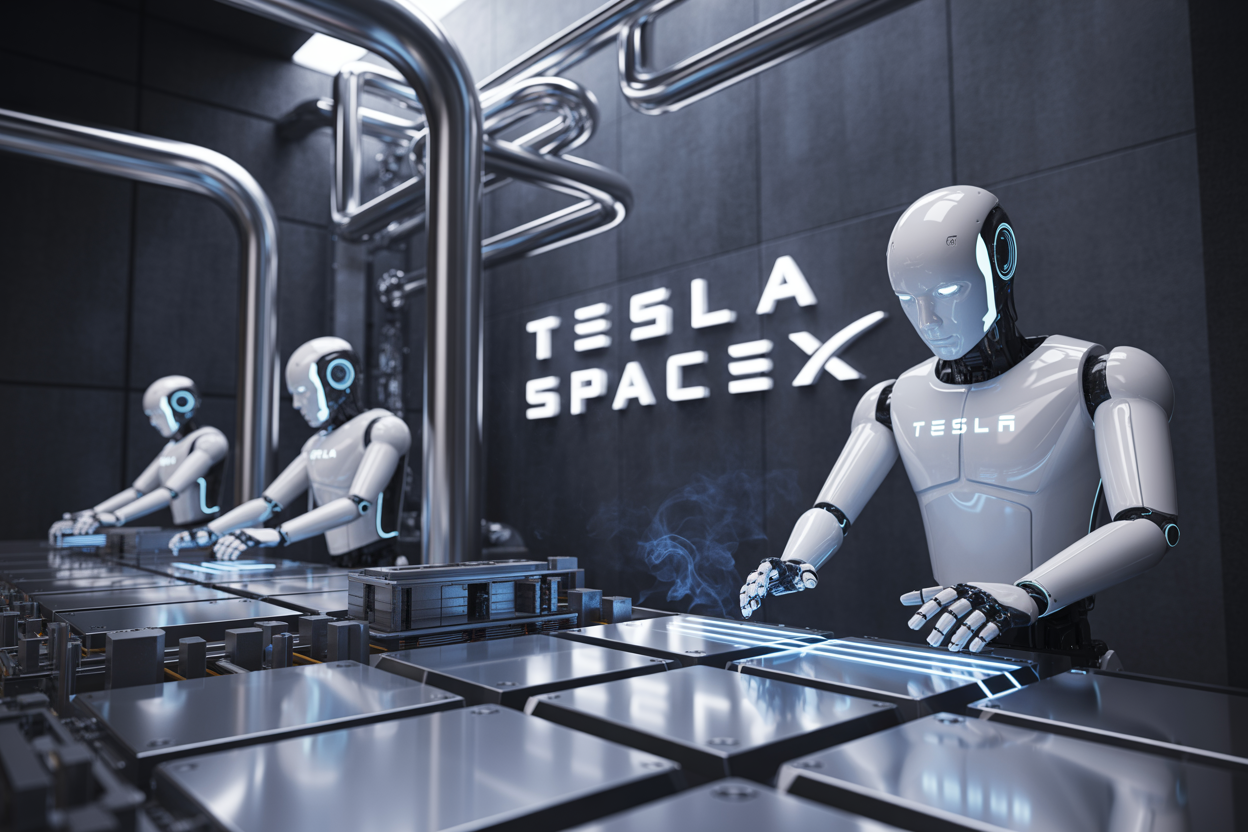
Musk clearly wants to become independent from major chip suppliers, while entering the market at the height of the boom. Bold plans that may soon come into force, for one prosaic reason – the decreasing availability of chips.
No chips? Tesla and SpaceX will build a factory
Musk’s rationale is so simple it’s disarming: “We either build Terafab or we don’t have chips. We need chips, so we build Terafab.” Semiconductor makers, he says, simply can’t keep up with his companies’ growing artificial intelligence and robotics needs.
The ambitions are impressive. The goal is to produce chips capable of handling 100 to 200 gigawatts of computing power per year on Earth, plus an additional terawatt in space. Yes – SpaceX apparently plans to process data in orbit. Musk did not provide any specific implementation dates, which (given his history with schedules) did not surprise anyone.
History repeats itself
It’s worth keeping a little distance here. Bloomberg directly reminds that Musk has no experience in semiconductor production, but he has an established reputation for making promises that mature much slower than expected. Let’s remember Cybertruck, Hyperloop or Tesla’s full autonomy – each of these projects went through a “soon” phase that lasted for years.
The market context speaks for itself
March 2026 is a time of exceptional turbulence for the semiconductor market. Global supply chains have still not fully recovered from the post-pandemic turmoil, and geopolitical tensions around Taiwan (and the US-Israel-Iran war) are effectively driving up prices and uncertainty. Additionally, the huge demands of Big Tech make the market situation increasingly difficult.
RAM prices are breaking new records, and analysts see no signs of upcoming stabilization. In such an environment, dependence on external chip suppliers becomes a real business risk and it is this risk that Musk will eliminate – Tesla and SpaceX will be safe. Regardless of whether Terafab will be built according to the vision or not – the direction of thinking itself is difficult to question.