
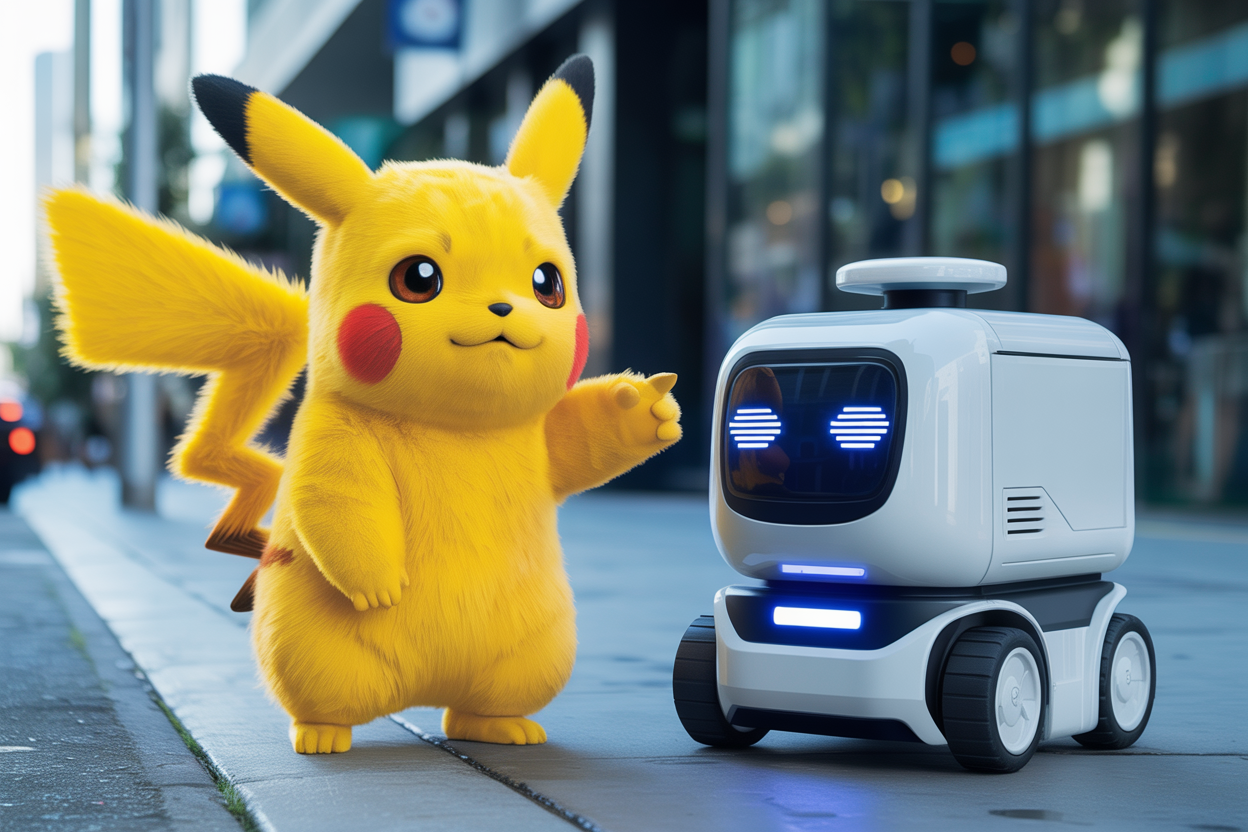
Exactly 10 years ago, the Pokemon Go game was the reason that millions of players left home. Young people and adults wandered around parks, parking lots and dark alleys, staring at smartphone screens in search of virtual creatures. It turns out that this massive, involuntary data collection campaign is now getting a second life, and in a surprisingly practical context.
How did the unconscious world mapping campaign work?
Niantic Spatial, part of the team behind Pokemon GO, has just announced a partnership with Coco Robotics, a manufacturer of food and shopping delivery robots. Soon, these autonomous delivery robots will roam city sidewalks using Visual Positioning System (VPS) technology, a navigation system that can pinpoint location to within a few centimeters by analyzing surrounding buildings and landmarks. Sound familiar? That’s because Niantic trained this system on over 30 billion photos collected by Pokemon GO players. Yes, catching your Charizard helped train the AI ;)
VPS differs from GPS in that it is not based on satellite signals, but on environmental recognition. Pokemon GO was the perfect tool in this respect – players had to physically reach specific places and photograph them from different angles – sometimes these were really extreme locations. In turn, in cities, players photographed each district very carefully and meticulously, because it was in urban areas that most Pokemon appeared and most Pokestops were located.
In 2020, the app added a “Field Research” feature, encouraging users to scan monuments and local attractions in exchange for in-game rewards. Effect? A gigantic, multi-layered 3D map of the real world, built over the years by tens of millions of users.
At its peak in 2016, Pokémon GO had approximately 230 million monthly active players. Today, despite its smaller cultural reach, the game still has an estimated 50 million active users – which means the data continues to flow in.
Pizza delivery as a test for AI
GPS fails in dense urban areas – the signal bounces off skyscrapers, the location “drifts”, and the robot gets lost halfway through the route. Coco robots are equipped with four cameras and thanks to VPS they know exactly where they are, even when satellites fail.
The promise of last-mile robotics is enormous, but navigating chaotic city streets is one of the toughest engineering challenges
– admits John Hanke, CEO of Niantic Spatial.
This is a classic example of secondary use of crowdsourcing data. Google’s CAPTCHA tests, which were probably used to train machine vision models, and data from the Waze application, allegedly shared with law enforcement agencies, aroused similar controversy.
Moreover, Niantic plans to build a “living map” of the world – a model that will be constantly updated by data collected by the delivery robots themselves. A similar mechanism drives the success of Waymo and Tesla in the autonomous driving industry today.
Next time you see someone chasing Pikachu in the park – know that they may be helping deliver someone’s pizza on time 😉