
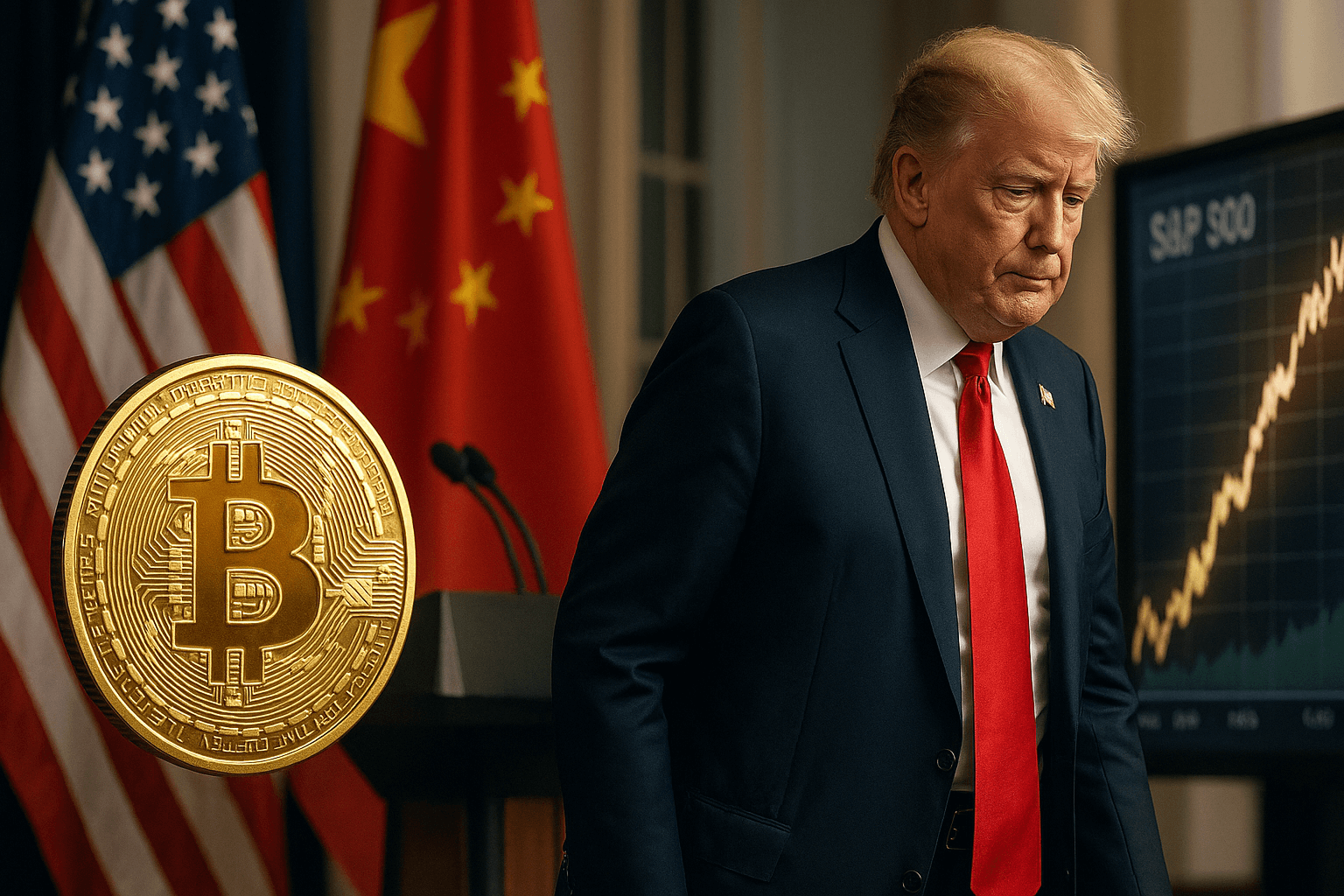
US President Donald Trump announced on Thursday morning that 100% tariffs on goods from China would not be maintained, triggering a slow return of positive sentiment in financial markets. This decision reverses the threat of escalation of the trade war, which has been causing panic among investors for the past week.
When reporters asked the President of the United States today whether high tariffs on China would be introduced, Trump replied briefly: “no.” This is a dramatic change in rhetoric from his October 10 announcement, when he said he would impose an additional 100% tariffs on Chinese products from November 1 in response to Beijing’s restrictions on rare earth exports.
Markets react with an immediate rebound
The markets’ reaction to Trump’s declaration was immediate. S&P 500 futures erased all of their overnight losses, gaining 75 points from the low in premarket trading. The pre-market showed that investor sentiment turned around quickly after weeks of uncertainty related to US-China trade relations.
Bitcoin, which is currently trading at $105,640 with a 24-hour decline of -2.28%, could also benefit from improved sentiment. Historically, tariff decisions between the world’s largest economies have had a significant impact on the cryptocurrency market, which is increasingly seen as a hedge against global economic volatility.
Trump-Xi meeting in two weeks
In another conciliatory gesture, Trump confirmed he would meet with Chinese President Xi Jinping within the next two weeks. The meeting will most likely take place at the APEC (Asia-Pacific Economic Cooperation) summit in South Korea, scheduled for October 31 – November 1.
Just a few days ago, Trump suggested the possibility of canceling this meeting, calling China’s actions “hostile” after Beijing announced export controls on 12 of 17 rare earth metals. China controls about 70% of global supplies of these key raw materials, needed to produce smartphones, electric cars, semiconductors and military equipment.
De-escalation after months of tensions
Trump’s announcement is the culmination of intense negotiations between Washington and Beijing. Treasury Secretary Scott Bessent said earlier this week that the two sides had “significantly de-escalated” the situation after a series of retaliatory actions that threatened to spark a new trade war.
Bessent said on Monday:
The lines of communication have been reopened, let’s see how this develops. A 100 percent tariff doesn’t have to happen
It therefore appears that the parties have already resolved their differences in negotiations.
The context of trade escalation
Tensions between the US and China have been systematically increasing in recent months. In April 2025, Trump imposed tariffs on China of up to 145%, to which Beijing responded with tariffs of 125%. Following negotiations in May, rates were reduced to 30% (US) and 10% (China) as part of a 90-day ceasefire, which was extended in August until November 10.
October’s threat of an additional 100% tariffs, which would be imposed on top of the existing 30%, raised fears of a return to levels close to a de facto trade embargo. Analysts warned that such a scenario could seriously disrupt global supply chains and trigger a recession in markets.
Impact on cryptocurrencies
For the cryptocurrency market, Trump’s retreat from tariff escalation may mean stabilization after a period of increased volatility. Bitcoin and other major cryptocurrencies have experienced sharp swings over the past week in response to intensifying trade rhetoric. BTC’s 24-hour trading volume increased by 49.62% to $109.39 billion, suggesting increased investor interest amid macroeconomic uncertainty.
Experts from the crypto industry indicate that long-term stability in US-China relations will be crucial to maintaining institutional investor confidence in digital assets. Positive developments may also support further adoption of Bitcoin as a global medium of exchange, independent of geopolitical tensions.
The upcoming Trump-Xi meeting will be a key moment for the future of the global economy and could significantly influence the direction of both traditional financial markets and the cryptocurrency market in the last quarter of 2025.