
I have already written on Bitcoin.pl about the draft act on cryptoassets by prof. Krzysztof Piech. I also wondered whether the project would be voted on in the Sejm. There are many indications that the Center will certainly not support it.
The Center criticizes the new law
The question remains whether the document will be voted on. Looking at the parliamentary arithmetic, there are chances for this.
There are 460 MPs. PiS, Konfederacja and Konfederacja Korona Polskiej, which will probably vote “for”, have a total of 207 MPs. Assuming the full composition of the chamber, there are only 24 missing. PSL itself has 32 MPs, so the People’s Party can ensure that the bill, which is supported by the industry, “passes”.
The problem is that it is already known that even the Center Parliamentary Club is “no”.
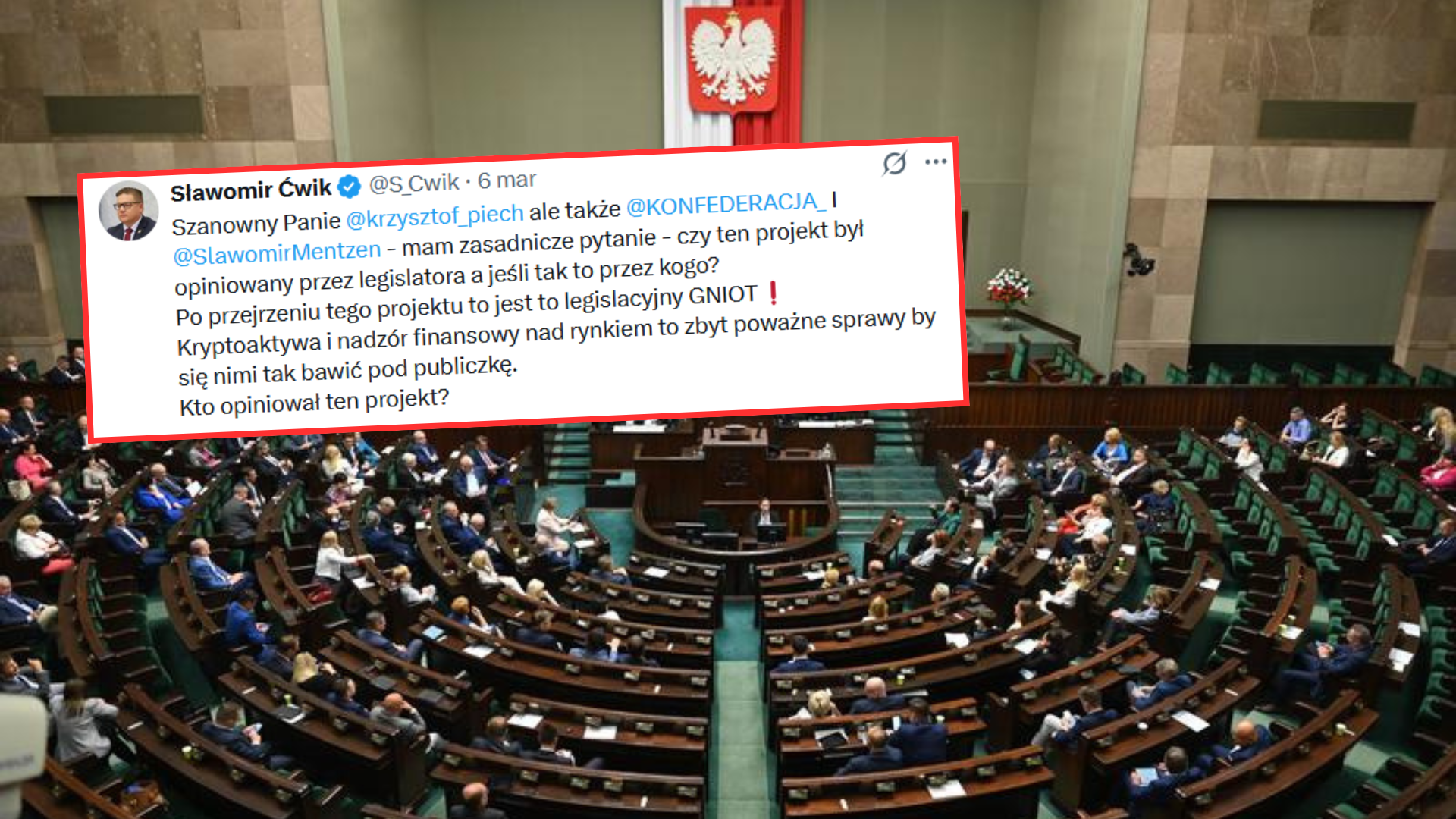
Dear Mr. Krzysztof Piech, but also Konfederacja and Sławomir Mentzen, I have a fundamental question – was this project reviewed by the legislator, and if so, by whom? After reviewing this project, it is legislative garbage! Cryptoassets and financial supervision of the market are too serious matters to be played with in public. Who reviewed this project?
– wrote on X Sławomir Ćwik from Centrum (original spelling).
It’s not “ours”, so we attack
He did not explain why he thought the project was “crap.”
His comments were quickly responded to by Prof. Piech and admitted that the project had been consulted, but not with the Legislative Office of the Sejm, nor with the Government Legislation Center. He added that he added self-corrections to the document.
This is the role of the Sejm: it should create law, slowly analyze projects and improve them. Mr. Ćwik’s attitude is unfortunately characterized by political boorishness: since the project is not “ours”, it should be crossed out immediately. If the Center wants to show that it is a substantive political force, it should respond to the bill with substantive arguments.
Despite all this, it is surprising that the Center does not even try to fight for the cryptocurrency electorate. Individual studies suggest that there may be from 1 million to 3-4 million voters.