
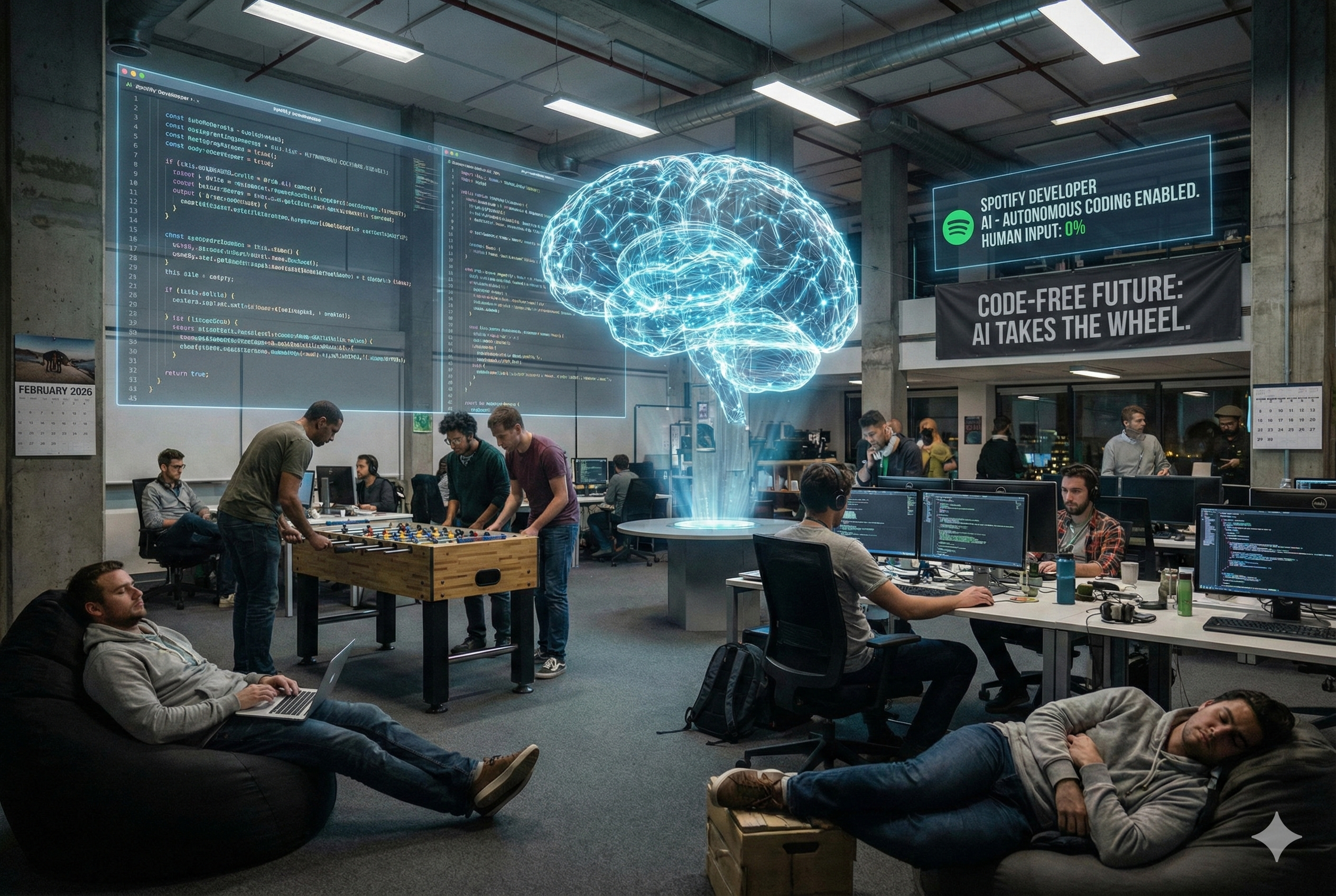
Has Artificial Intelligence Reached a Breakthrough Point in Programming? In the case of Spotify, the answer is yes. During the fourth quarter earnings conference call, co-CEO Gustav Söderström said something that is now being quoted all over the internet: the company’s top developers “haven’t written a single line of code since December.” And no, no one fired anyone. Will AI and vibe coding actually replace programmers? And if so, is this really the right way?
Vibe coding instead of real coding
Spotify has implemented an internal system called “Honk”, which uses Claude Code for lightning-fast deployment. What does it look like in practice? An engineer on his way to work, sitting on the tram and browsing Slack on his phone, might tell Claude to fix a bug or add a new feature to the iOS app. Before he gets to the office, he gets a ready version of the app – straight to Slack. Just click “merge to production” and that’s it.
This is the so-called “vibe coding” – programming through intention, not code. Sounds like science fiction? And yet it works. Spotify released over 50 new features and changes in 2025, including AI-based Prompted Playlists, Page Match for audiobooks and “About This Song”.
More than just a tool
Söderström does not hide his enthusiasm. The system “dramatically” accelerates product development, and this is just the beginning. But Spotify doesn’t just copy what others do. The company is building something that cannot be stolen – a unique dataset of music preferences that no LLM will find on the Internet.
Let’s take training music. For Americans, it’s mostly hip-hop (though millions prefer death metal). Europeans focus on EDM, but Scandinavians train to heavy metal. This is knowledge that is not found on Wikipedia or any publicly available dataset. Spotify trains its models on this and with each iteration they get better.
The company also takes a pragmatic approach to AI-generated music – it allows artists and labels to mark how a song was produced in metadata, while also fighting spam on the platform.
Why is Spotify getting into AI so strongly? The answer – competition!
Suno, the giant that is responsible for probably 95% of the AI-created music numbers you hear on the Internet lately, has agreed to somehow merge with Warner Music, thanks to which Suno will soon become a portal closed solely behind a paywall. Free users will be able to listen to user-generated songs, rate them and use them on social media.
This means that Spotify needs to radically change the way it approaches its audience. Although the streaming giant’s strength is still authenticity and a huge library, playing with AI music may effectively distract users who have recently been increasingly boycotting subsequent price increases for subscription plans.
Worse case scenario? Programming without programmers
Exaggeration and coloring, but for a specific purpose – although today seniors simply control the AI and check the written code, in the next few years and going all out with vibe coding may lead to a disaster.
The pessimistic scenario looks bleak. In a few years, programming may become a lost profession – like the telephone operator who connected calls manually. Juniors will have no way to learn because there will be nothing to do. Seniors will become archaeologists of their own industry, remembering the times when code was written with fingers, not prompts.
Spotify shows the future. The question is whether we really want to live in a world where more and more responsibility will be placed on LLMs and vibe coding.