
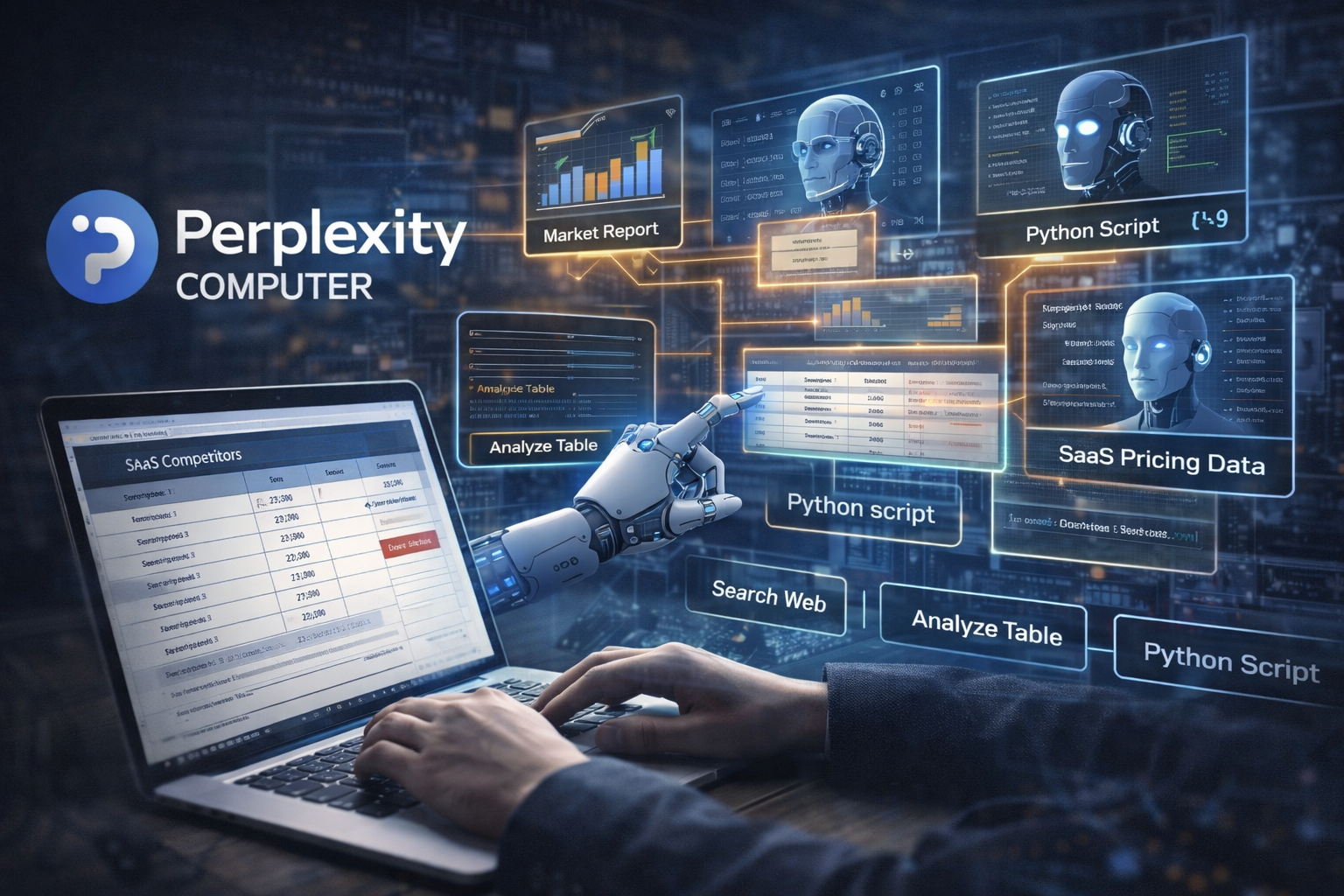
Perplexity started as a search engine intended to replace Google. Instead of returning a list of links, it synthesized the results into specific answers with quotes. Now the company is taking a step that changes the product category – from a tool that answers questions to an agent that performs tasks. Will Perplexity Computer turn out to be a better product than the security-vulnerable AI Comet browser?
Perplexity – from chatbot to agent
Perplexity Computer is a multi-model system that accepts commands in a natural language and independently plans work, browses the Internet, manipulates files and calls external APIs. The result is not a response in the chat – it is a ready-made project: a summary of data in a spreadsheet, a market report, a CRM statement confronted with your customer database.
How does the orchestration layer work?
To make this work, Perplexity built its own orchestration layer. Instead of pushing everything through one large model, the system decomposes the task into subtasks and routes each of them to a specialized LLMa. A task requiring chain-of-thought goes into a chain-of-thought-optimized model.
Generating a Python script – for a model specialized in code. Extracting data from PDF with tables? A model with vision capabilities is coming. Orchestration manages the state of the entire flow, fires tools at the right moment, and glues everything together into the final result.
In practice, it looks like this: the user types in “research the prices of five SaaS competitors and make a comparison table.” The agent navigates the “pricing page”, extracts data, and when he comes across “Contact Sales” instead of a price list, he marks this line as requiring manual verification. No manual intervention between steps.
Price and availability
Access to Perplexity Computer costs $20 per month on the Pro plan – a price intentionally set as consumer, not enterprise. For comparison, OpenAI’s Pro plan is $200/month, though the two products differ in scope. Perplexity plays the accessibility card.
The second differentiator is the retrieval infrastructure built from the ground up for search: the agent has a built-in backbone for grounding responses in real web data, rather than adding it as a patch. It is worth adding that Perplexity has recently had major problems with hallucinations, so their new AI uber-agent must certainly be tested by many users to rule out such complications. In the case of AI agents, hallucinations can be very dangerous.
Weaknesses and limitations
Complex multi-step flows have a ceiling – cascading errors in subtasks can degrade the final result. Each step accumulates the risk of hallucination, which, as I mentioned above, is high. Perplexity has not released latency or rate caps for agent modes. When delegating sensitive tasks – financial data, access to production APIs – human verification is not an option, it is an obligation.
What does this mean for the market?
AI agents are no longer just a feature glued to the chat interface and are becoming stand-alone products. The question for the market is not “which model has the best benchmarks?”, but “which orchestration layer delivers the most reliable end-to-end flows?”. Perplexity has set its answer and is waiting for developments. Why? Because in the agent industry, competition is like a cheetah on the hunt – it waits for its prey to stumble.