

JP Morgan Asset Management has presented scenarios for long-term bitcoin returns for the first time. The base one assumes 10% per year for 10 years, taking into account compounding of profits. At the same time, it does not add BTC to the main models used to build wallets. The reason is the large fluctuations and unstable relationships between bitcoin and other assets.
- The base case scenario for Bitcoin assumes 10% per year compounded over 10 years. This does not mean an increase of 10% every year.
- In the table, JPMorgan also reports an arithmetic mean of 20.9% and an annual volatility of 55%. These numbers describe various features of the adopted model.
- BTC has a separate breakdown with selected assets, but remains outside the main relationship models between them. This is not information about the composition of all bank client portfolios.
What JPMorgan published
JP Morgan Asset Management published the 31st edition of “Long-Term Capital Market Assumptions” on October 19. The study for 2027 helps managers compare the potential results and risk of investments over the next 10-15 years. A separate analysis of bitcoin includes 10-year scenarios.
How are you finding your way in the new crypto reality? Join the Bitcoin.pl report
Zondacrypto, DAC8, MiCA. A lot is changing around cryptocurrencies. We want to check whether and how these changes influenced the decisions of Bitcoin.pl readers. The survey is anonymous, participation is voluntary, and it takes about 2 minutes to complete. Your answers will help create a report showing how Poles perceive cryptocurrencies and how they approach investing in the new reality. If you don’t have cryptocurrencies, you can participate too.
The survey is anonymous and voluntary. You can choose not to answer every question. We do not collect your name or IP address. We only publish the results collectively. Privacy Policy
Why 10% and 20.9% are different results
The arithmetic mean is the sum of annual returns divided by the number of years. However, it does not say how much the capital ultimately increased. For this, you need a compound rate, which takes into account that each subsequent profit or loss applies to the already changed amount.
Let’s assume you invest PLN 100. After an increase of 60% you have PLN 160, and after a decrease of 40% you have PLN 96 left. The average of the two yearly changes is 10%, although in total you lose 4%. In this example, the annual compound rate is negative.
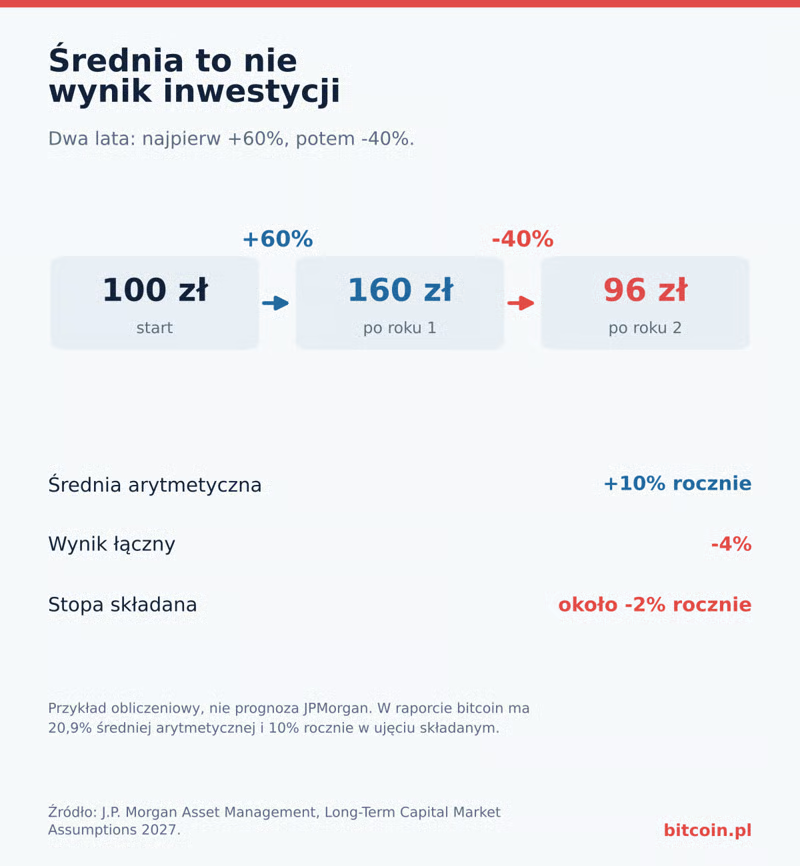
Therefore, the model 20.9% of the arithmetic mean does not mean that capital will grow at this rate throughout the decade. The 10% compound rate provided by JPMorgan is used to calculate the multi-year scenario. The assumed annual volatility of BTC is 55%, compared to 18% for large US companies and 17.2% for gold. These are not limits on possible losses.
At a compound rate of 10%, the capital is PLN 100,000. PLN would increase to approximately PLN 259,000. PLN after 10 years, and after 15 years to approximately PLN 418,000. zloty. This is a mathematical example, without costs, taxes and exchange rate changes. The second result is an extension of the calculation, not the 15-year BTC scenario from the report. For an investor settling a purchase in PLN, the dollar exchange rate is also important: 10% in USD does not necessarily mean 10% in PLN.

Why bitcoin remains outside mainstream models
JPMorgan did not include bitcoin in its main covariance matrices, which are tables that describe how changes in the value of various assets are related to each other. He prepared a separate, smaller table for him. Such an analysis allows you to compare BTC with stocks or gold, but it does not indicate what share it should have in the portfolio.
Analysts believe that it is too early to treat bitcoin as a permanent means of diversification. Its dependencies with other assets are unstable and fluctuations are large. They allow for a change in approach if these relationships stabilize and volatility decreases. Market development and greater regulatory clarity are also important.

What does this forecast tell the investor?
The 10% result is a base case, not a promise of annual profit. Even achieving this rate in an entire decade would not rule out deep declines along the way. Selling at one such moment could result in a result that is much worse than the assumption for the full period.
QUIZ FOR THE FIRST TIME
210 questions, 21 seconds each
From 10,000 BTC pizza to the secrets of cryptography. Test your knowledge about Bitcoin and crypto. The record is 22 hits in a row – can you break it?