
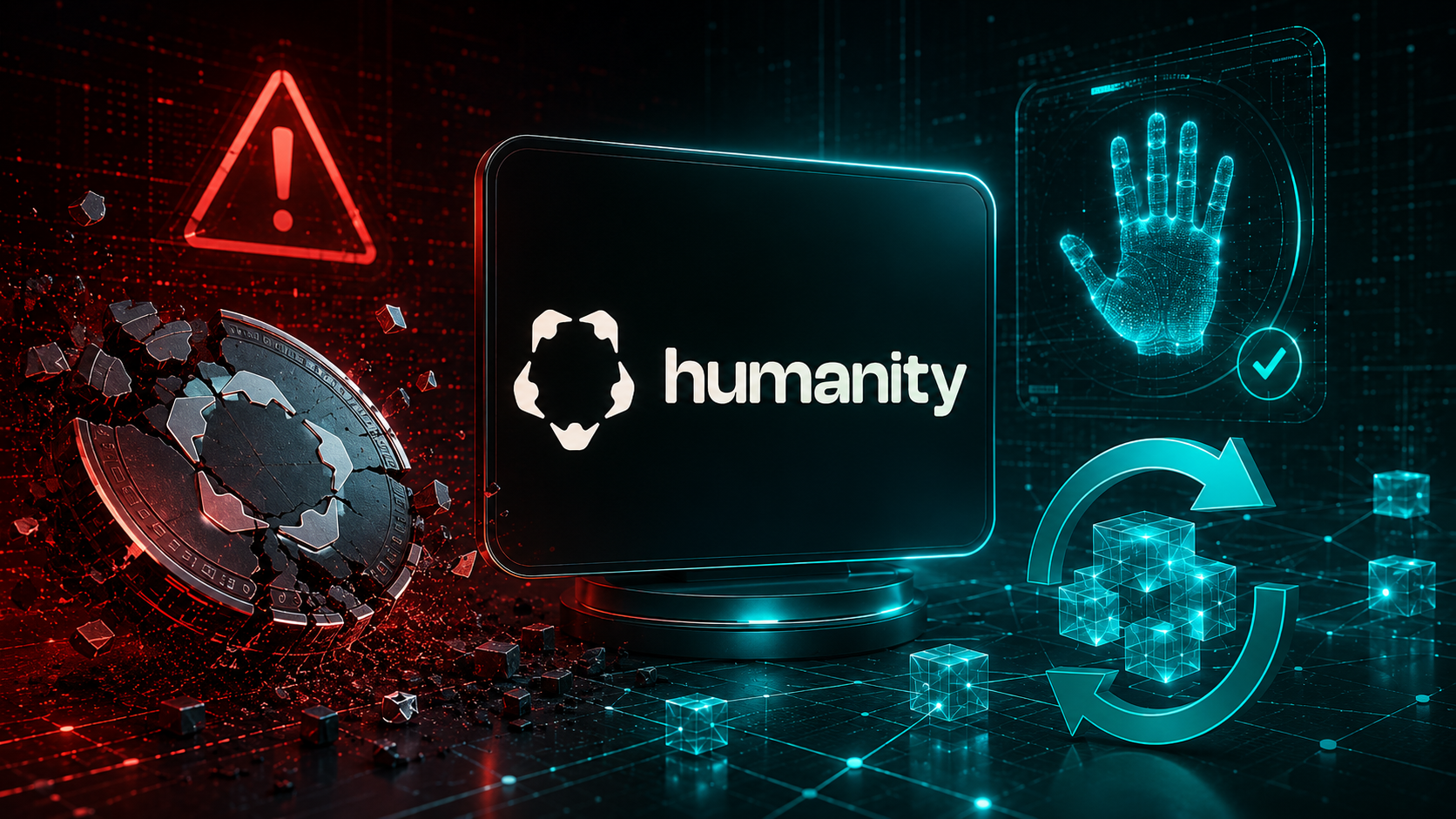
Humanity Protocol, a project dealing with decentralized identity verification, is trying to rebuild trust after one of the most high-profile attacks in recent days. According to estimates, losses after the H token exploit reached approximately USD 36 million. The team has already announced a rescue plan: the old token will be expired, a new audited ERC-20 contract has been created, and eligible holders will receive new tokens in a 1:1 ratio.
This is an important story not only for H holders. It also shows one of the biggest problems of the crypto industry: even the best idea and code audit are not enough if private key management fails.
The most important information
Humanity Protocol fell victim to an attack on June 8, 2026. According to available analyses, the cause was not a classic error in the smart contract, but the interception of the private keys of one of the team members.
The attackers took over the keys saved in the backup on the infected device. Thanks to this, they were able to gain control over elements of the project’s infrastructure, withdraw tokens from the Ethereum bridge and mint new tokens on BNB Smart Chain.
The H token rapidly lost value. At the worst moment, the decline was as much as 80-90% compared to pre-attack levels.
On Tuesday, June 16, Humanity Protocol presented its recovery plan. It includes the expiration of the old H token, implementation of the new ERC-20 contract, snapshot of balances from the moment of the attack, 1:1 airdrop and a compensation fund for more difficult cases.
What is Humanity Protocol?
In practice, it is a digital identity infrastructure for the Web3 world. This type of solutions can be used, among others: in airdrops, DAO votes, social media, games, financial services and applications that require protection against Sybil attack, i.e. the creation of many false identities by one person.
The goal is to create a system where a user can prove they are human, but without revealing full personal information.
What exactly happened on June 8?
The attack occurred on June 8, 2026 around 17:25 UTC. According to information published by the project and companies analyzing the incident, the source of the problem was the interception of private keys from the computer of one of the team members.
The keys were supposed to be in the backup that was transferred to the device during earlier work related to launching the project infrastructure. The computer has been infected with malware. According to available findings, the scenario could have started with phishing, i.e. a fake message impersonating a trusted entity.
After gaining access to the keys, the attackers could perform operations that, from the blockchain point of view, looked like the actions of an authorized administrator.
On Ethereum, the bridge contract was maliciously updated and approximately 141 million H tokens were withdrawn. On BNB Smart Chain, hackers were able to mint additional tokens.
According to the analyses, in total, hundreds of millions of H tokens were stolen or unauthorized issued. Some of them were then sold on decentralized exchanges, which caused strong supply pressure and a sharp drop in price.
It wasn’t a code bug, it was an operational security bug
This case is particularly interesting because it does not look like a classic smart contract exploit. In many DeFi attacks, the hacker exploits a flaw in contract logic, an asset pricing error, an Oracle problem, or a poorly designed flash loan mechanism.
Here the problem was different. The attackers obtained private keys, i.e. digital “permissions” that allow them to control critical elements of the project.
This is an important difference. If the hacker has the correct keys, he also has full rights as a real administrator. The transaction is technically correct, the signature is correct, and the damage happens at the access management level.
This is why there is so much talk in crypto about multisigs, cold storage, hardware wallets and key separation. Multisig only makes sense if the keys are truly distributed. If several keys needed for authorization are on one device or in one backup, security becomes an illusion.
Humanity Protocol announces rescue plan
On Tuesday, June 16, Humanity Protocol presented a plan to rebuild the ecosystem after the attack. The most important decision: the old H token will be phased out on Ethereum, BNB Smart Chain and Humanity Mainnet.
In its place, a new H token appeared as an audited ERC-20 contract on Ethereum. The new contract address is:
0xE76c5b78f93909d34404E9eb4C1f19e7582a5dE1
The project announced that eligible holders of the old H will receive the new token in a 1:1 ratio. The basis for distribution will be the snapshot taken at the time of the attack, i.e. on June 8, 2026 at 17:25:35 UTC.
The snapshot covered balances on Ethereum, BNB Smart Chain and Humanity Mainnet. Addresses associated with the attacker are to be excluded from distribution.
For regular user wallets, the process should be relatively simple. If someone had an H on their own address before the snapshot, they should be eligible to receive a new token.
Cases related to DeFi, exchanges, liquidity pools and smart contracts will be more difficult.
H Compensation Fund, i.e. a fund for more difficult cases
Humanity Protocol also announced the creation of the H Compensation Fund. It is intended to help users whose situations cannot be easily resolved by regular airdrop.
This includes: o people who had tokens in liquidity pools, DeFi protocols, smart contracts or external integrations. The fund is also intended to cover some users who bought H after the snapshot and still have tokens.
However, in this case there will be no automatic compensation. The project announces verification of claims and, in some cases, also KYC/AML procedures. This is due to, among others, from findings regarding the attackers’ potential links with North Korean groups.
The most important thing for users right now is caution. After such incidents, fake claim websites, fake social media profiles and scam links in comments often appear.
If someone had or still has H, they should only use the official Humanity Protocol channels or the announcements of the exchange where they held the tokens.
What about exchanges and Humanity Mainnet?
Humanity Protocol declares that it cooperates with centralized exchanges, liquidity providers, bridges and ecosystem partners. This is important because token migration does not only apply to people who hold H on private wallets.
If the tokens were on the exchange, the user should follow the announcements of the specific platform. It is the exchange that will decide whether and how it will support the migration, when it will resume deposits and withdrawals, and how it will treat trading in the old and new H.
The project also announced a restart of the Humanity Mainnet in the coming weeks. The new H token is intended to act as a native gas token in this network.
This will be an important test for Humanity Protocol. Airdrop alone is not enough to rebuild trust. The market will watch whether the project can efficiently restore the infrastructure, sort out integrations and show that a similar mistake should not be repeated.
Does Humanity Protocol have a chance to come back to life after such an attack?
On the one hand, the team’s response is relatively quick and specific. Humanity Protocol did not limit itself to a short statement, but presented a plan: a new contract, snapshot, 1:1 airdrop, compensation fund and mainnet restart.
This is a better scenario than many projects that, after major exploits, communicate chaotically or try to shift responsibility.
On the other hand, the problem is serious. Humanity Protocol works in the area of digital identity, privacy and trust. If a project building proof of humanity infrastructure loses control of critical keys, it is not only a financial but also an image-related blow.
The biggest challenge will not be just creating a new token. The biggest challenge will be to convince users, investors, exchanges and partners that security procedures have been realistically improved.
The market will want to see answers to several questions. How are keys stored now? Have multisigs been overhauled? Has there been better separation of permissions? Has the project undergone an independent operational security audit, not just a code audit?
Without this, a new token may solve the technical problem, but it will not solve the trust problem.
Lesson for the crypto market
Hack Humanity Protocol reminds that in Web3, security does not end with smart contracts. Code auditing is important, but it won’t protect the project if critical private keys are stored incorrectly.
This is especially important in projects that control bridges, have administrative rights, manage high liquidity or operate multiple networks at the same time. The more that depends on several keys, the greater the risk that one human error will lead to a disaster.
For users, the conclusion is equally simple: in crypto, you need to look not only at the narrative, investors and technology, but also at the way the project is managed. Sometimes the greatest risk is not a hacker looking for an error in the code, but a poorly secured laptop, backup or seed phrase.
Humanity Protocol still has a chance to rebuild the project. It has a current narrative, a specific market segment and a recovery plan. But after such an incident, trust cannot be regained with promises. They are regained by executing the plan, being transparent and showing that the same mistake cannot happen again.