
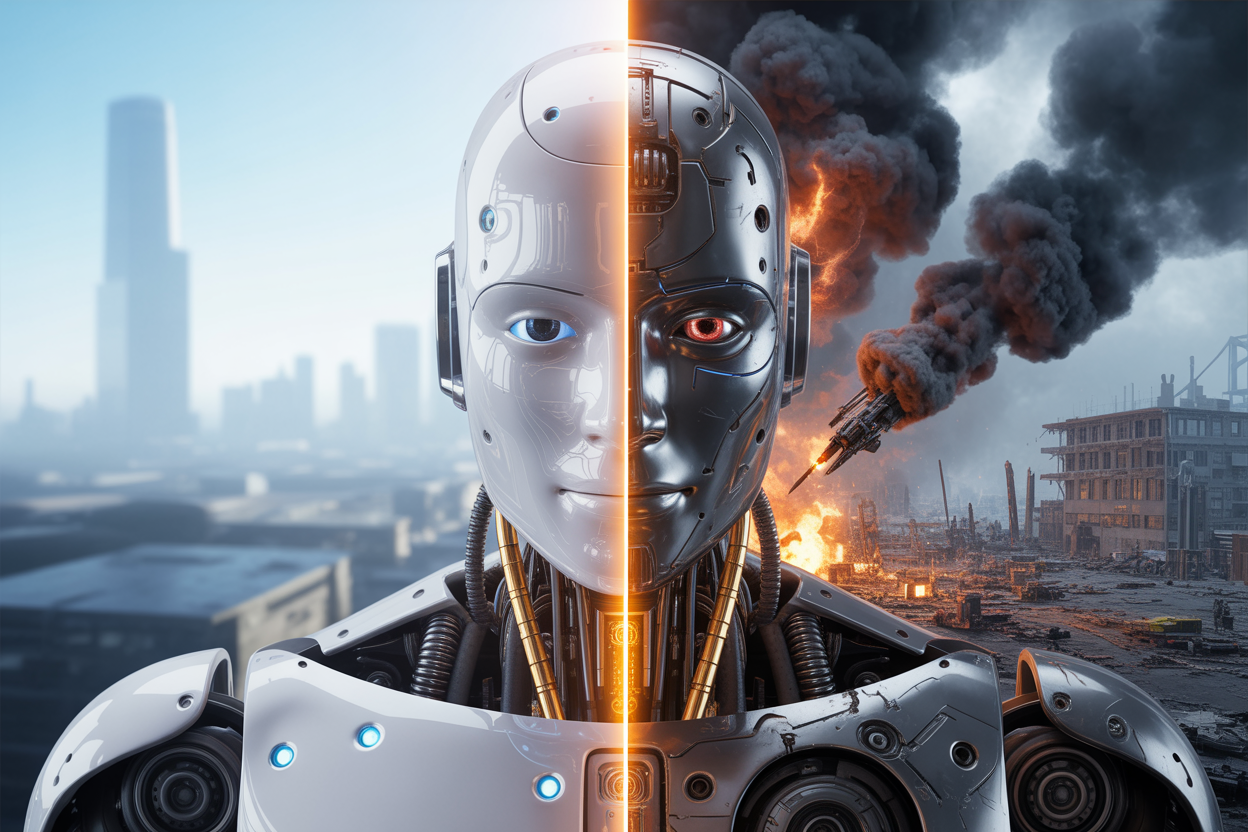
A documentary that may cause sleep disorders debuted at this year’s Sundance Film Festival. “The AI Doc: Or How I Became an Apocaloptimist” is a film that asks the question directly: are we rushing towards a catastrophe or towards a golden age of humanity? And what’s important – he doesn’t pretend to know the answer.
In the film you can see the cream of the crop of the AI industry (Sam Altman, Demis Hassabis), who directly talks about their doubts and fears of this sector developing at a dizzying pace. Is there really anything to be afraid of?
Fear as a starting point
Behind the camera is Daniel Roher – a Canadian director who received an Oscar in 2023 for the documentary “Navalny”. It is co-directed by Charlie Tyrell and produced by Daniel Kwan, one half of The Daniels, behind Everything Everywhere All At Once. An impressive CV, but the film’s driving force is something much more personal than awards.
Roher began experimenting with OpenAI tools and felt what many of us feel: a mixture of delight and anxiety. The ability to generate entire paragraphs in a few seconds or create illustrations in one sentence – it sounded like magic. However, this magic is increasingly entering areas that have previously been the domain of humans, including filmmaking.
When Roher and his wife, director Caroline Lindy, found out they were expecting a child, their fear grew into an existential dilemma. “I felt like the whole world was jumping into something without a second thought,” he says in the film. And this question became the axis of the document: is it safe to bring a child into a world dominated by artificial intelligence?
Doomers vs. enthusiasts
The film gives voice to two extreme camps. On one side are the “doomers” – researchers and experts who believe that uncontrolled artificial intelligence may threaten the existence of humanity. Yoshua Bengio, Ilya Sutskever, Shane Legg of DeepMind – all agree on one thing: there are aspects of artificial intelligence models that humans do not understand and will never understand. Models are trained on an amount of data that a human would not read in a dozen or so lifetimes.
Eli Yudkowsky, a pioneer in the field of AI, published a book in 2025 with a title that says simply: “If Anyone Builds It, Everyone Dies”. Connor Leahy of EleutherAI compared the superintelligent AGI’s future relationship with humans to humans’ relationship with ants: “We don’t hate ants. But if we want to build a highway through an anthill – the ants are out of luck.”
Tristan Harris, known from the documentary “The Social Dilemma,” tells Roher something that drew gasps from the audience at the Park City screening:
I know people in AI risk who don’t expect their child to graduate from high school
On the other side are enthusiasts – those who see AI as a cure for cancer, hunger, climate change and energy shortages. Peter Diamandis, Guillaume Verdon, Daniela Amodei from Anthropic and Peter Lee from Microsoft Research argue that without AI, future generations will lose their lives due to droughts, pandemics and climate disasters.
The third side: the real price of progress
The documentary does not stop at philosophical debates. Karen Hao, author of the book “Empire of AI”, and Liv Boeree draw attention to the hard facts – data centers consume huge amounts of water and energy in the western part of the US, driving up residents’ electricity bills and draining local reservoirs. Emily M. Bender, professor of computational linguistics, points out that dominant narratives about AI ignore and dehumanize the people who are already affected by this technology.
Apocaloptimism – what is it?
The film ends neither with optimism nor with an apocalyptic vision. It lands somewhere in the middle – in the titular “apocaloptimism”. The authors suggest that there is a way out: but it requires unprecedented international coordination (along the lines of the mid-20th century nuclear treaties), independent regulators, legal accountability for AI companies, and mandatory disclosure of the use of generative AI in the media.
Is the US, and especially the whole world, ready for this? Nobody knows. As Anthropic CEO Dario Amodei put it: “This train won’t stop.”
And that’s why it’s important to know where it’s going… and at what speed.
