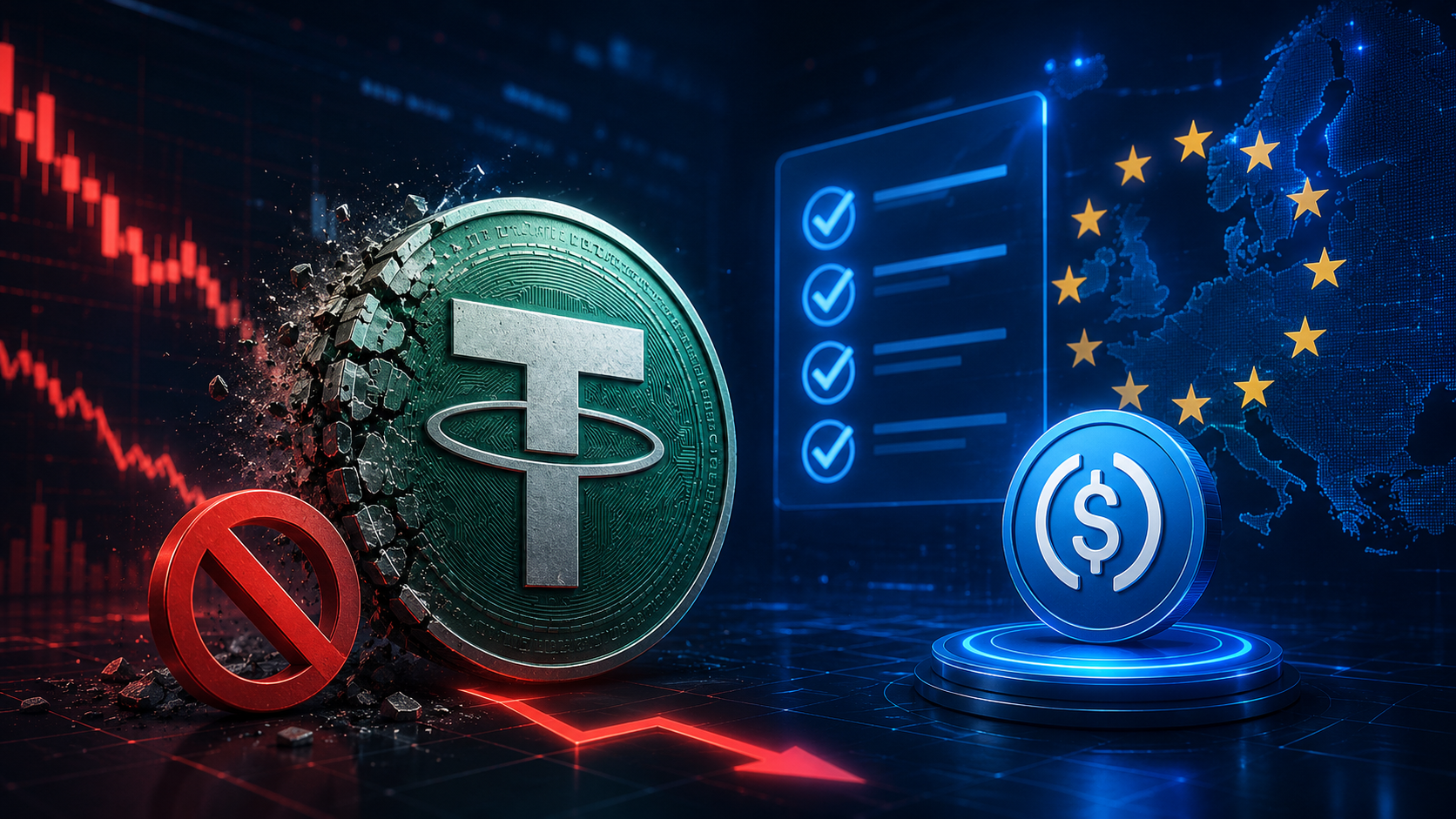
The world’s largest stablecoin has found itself outside the mainstream of the regulated cryptocurrency market in the European Union. USDT, whose capitalization is approximately USD 186 billion, remains a global giant, but for users from the European Economic Area its availability on licensed exchanges has been severely limited.
This does not mean that Tether “ceases to exist” in Europe. However, it means that it will become increasingly difficult to trade it as before on regulated platforms operating under MiCA. For many users, stablecoins compliant with EU regulations, primarily USDC and selected euro stablecoins, become a natural alternative.
What exactly happened?
In the case of stablecoins, the key requirements are authorization, transparency, reserves, the right to redeem tokens and supervision of the issuer. Issuers wishing to offer their stablecoins in the EU within a regulated market must meet certain MiCA requirements.
Tether, the issuer of USDT, has not achieved MiCA-compliant status for USDT. As a result, large exchanges serving users from the European Economic Area began to withdraw or restrict trading in USDT-based pairs.
USDT delisting in Europe is not an ordinary regulatory event. This is a signal that the EU is consciously giving up its competitive position in the global crypto market in favor of control over the financial infrastructure.
MiCA has created a de facto stablecoin monopoly in Europe. USDC is now the only player on the regulated market, and although Circle meets the formal requirements, the concentration of the entire European stablecoin trade in one entity is a systemic risk that regulators seem to ignore.
Capital is already reacting. European cryptocurrency projects are registering in Dubai, Singapore and the Cayman Islands not because they want to avoid regulation, but because in the current EU legal environment, building innovative financial products is simply unprofitable.
The biggest strategic question is different: is MiCA a regulation of the crypto market or the preparation of infrastructure for the digital euro? The elimination of decentralized and non-EU-linked payment instruments from licensed platforms is exactly the step that would need to precede the successful implementation of CBDC on a mass scale. Maybe it’s a coincidence. Maybe not.
The European crypto market is moving towards a model in which the availability of financial instruments is determined by an official, not the market. History shows that such an environment does not produce innovation. It produces regulatory arbitrage and capital outflow, which is the least Europe can afford at the moment.
What about July 1, 2026?
The July 1, 2026 date is important, but needs to be understood well. This is the end of EU transition periods for crypto service providers that previously operated under national registration or local rules. After this date, companies providing crypto services to EU clients should have the appropriate MiCA authorization. Otherwise, they will not be able to legally continue to offer services on the EU market.
In practice, this means further ordering of the European cryptocurrency market. Exchanges, brokers and other service providers will have to operate under the full MiCA regime or withdraw from serving EU clients. In the case of USDT, however, the most important restrictions started earlier. So it is not the case that on July 1, 2026, USDT will suddenly disappear from Binance, Coinbase or Kraken. Many major platforms have already restricted or disabled USDT trading for EEA users.
Why hasn’t Tether adapted to MiCA?
Tether has long criticized some of the EU requirements. The most controversial issues are the rules regarding stablecoin reserves and the obligation to keep a large part of assets in bank deposits.
From the regulators’ perspective, this is to increase user security, transparency and the possibility of redeeming tokens. However, from Tether’s perspective, this could create new risks, especially if a large part of the stablecoin’s reserves would have to be concentrated in traditional banks.
This is a dispute about market philosophy. The European Union wants stablecoins that are more like regulated electronic money. Tether focuses on a global operating model, less dependent on the European banking system.
Who benefits? Circle and USDC
The biggest beneficiary of the changes is Circle, the issuer of USDC and EURC. Circle has achieved MiCA compliance through a French e-money institution license, allowing USDC and EURC to function as regulated e-money tokens in the European Economic Area.
This is a big advantage for exchanges operating legally in the EU. If the platform wants to comply with regulations, it is easier for it to offer stablecoins whose issuer meets MiCA requirements.
This does not mean that USDC is risk-free. Stablecoins still depend on the quality of reserves, liquidity, supervision, redemption conditions and the decisions of the issuer. The difference is that USDC has now become the most important large dollar stablecoin that fits European regulations.
What does this mean for the Polish user?
If you hold USDT on a centralized exchange, check the specific platform’s announcement. Each exchange may have its own rules regarding trading, deposits, withdrawals, conversions and products such as earn, margin or futures.
The most common scenario is as follows: USDT trading on a regulated platform is restricted or unavailable, but withdrawing funds to your own wallet should remain possible. Some exchanges also allow the conversion of USDT to USDC, EUR or other supported assets.
There is no need to panic, but it is worth acting consciously. The worst solution is to ignore the exchange’s announcements, especially if USDT is included in savings, loans, margin products or automated strategies.
Will USDT still work in Europe?
Yes, but not everywhere and not in the same way.
USDT can still function in self-custody wallets and on decentralized exchanges. Blockchain does not check whether the user is located in Poland, Germany or France. If you have USDT on your own wallet, the token technically still works.
The problem concerns primarily regulated intermediaries: exchanges, brokers and platforms that want to legally serve customers from the European Union.
This means market division. Some users will switch to USDC, EURC or other MiCA-compliant stablecoins. Some more advanced users will stick with USDT, using their own wallets, DEXs and infrastructure outside the centralized exchanges in the EU.
What can you do?
If you use USDT, start with a simple overview:
- Check if your exchange still allows you to trade USDT.
- Verify if you can withdraw USDT to your own wallet.
- Check if you have USDT in Earn, Lending, Margin, Futures or Trading Bot products.
- Compare costs and conversion rates to USDC, EUR or other stablecoins.
- If you use DEXs, make sure you understand the risks of self-custody, network fees and liquidity.
The simplest option for novice users is to switch to stablecoins supported by regulated exchanges in the EU. More advanced users can still use USDT outside of CEXs, but this requires more responsibility and technical knowledge.
Euro stablecoins may also gain
Changes around USDT may help not only USDC but also euro-pegged stablecoins. Tokens such as EURC or EURI may become increasingly important in Europe.
This is important because the crypto market has been almost entirely dollar-based for years. Most liquidity, trading pairs and settlements were based on USDT or USDC. MiCA may gradually increase the importance of euro-denominated stablecoins, especially among users and companies operating in the EU.
It won’t happen overnight. USDT still has huge global liquidity, especially outside Europe. But for regulated entities in the EU, the direction is clear: MiCA-compliant stablecoins will have an advantage.
Summary
USDT is not disappearing from the global market. It does not disappear completely from Europe either. However, it disappears from convenient, regulated circulation on the largest exchanges serving users from the EEA.
This is one of the most important consequences of MiCA for regular cryptocurrency users. Until now, regulations have often seemed distant, mainly affecting stock exchanges, lawyers and institutions. Now their effects can be seen directly in users’ wallets.
For some, it is a step towards greater security and transparency. For others, it is market centralization and pushing liquidity outside Europe.
One thing is certain: the European stablecoin market after MiCA will look different than before. And anyone using USDT should check what rules apply to their exchange before being surprised by restrictions.
This is not investment advice. Stablecoins, despite their stable price against the dollar or euro, still involve risks of the issuer, liquidity, regulation and the infrastructure used by the user.