
On November 11, 1918, Poland regained independence after 123 years of partition. Few, however, remember that for the following years the reborn country did not even have its own single currency. The history of Polish money reminds us that political freedom and economic independence are closely related. Today, 108 years later, it is worth looking at this history also through the prism of contemporary questions about money, trust and financial independence. Also those that Bitcoin puts before us.
November 11 holds a special place in Polish history. It is a day of remembrance of the generations that have not come to terms with the loss of statehood, of people fighting for freedom on battlefields, but also of those who have preserved Polish culture, language and national identity for decades.
It is worth remembering that independence was not the work of one man or one community. Józef Piłsudski, Roman Dmowski, Ignacy Jan Paderewski, Wincenty Witos and Ignacy Daszyński often represented different visions of Poland. Their activities, like the efforts of thousands of lesser-known Poles, contributed to something that seemed extremely difficult to achieve just a few years earlier.
These tasks included one more that is relatively rarely talked about during Independence Day celebrations: creating your own monetary system.
Independent Poland had four currencies. There was no zloty yet
In November 1918, there were four main currencies in Poland: the Russian ruble, the Austro-Hungarian crown, the German mark and the Polish mark. The latter, contrary to its name, was introduced during the German occupation of the lands of the Kingdom of Poland.
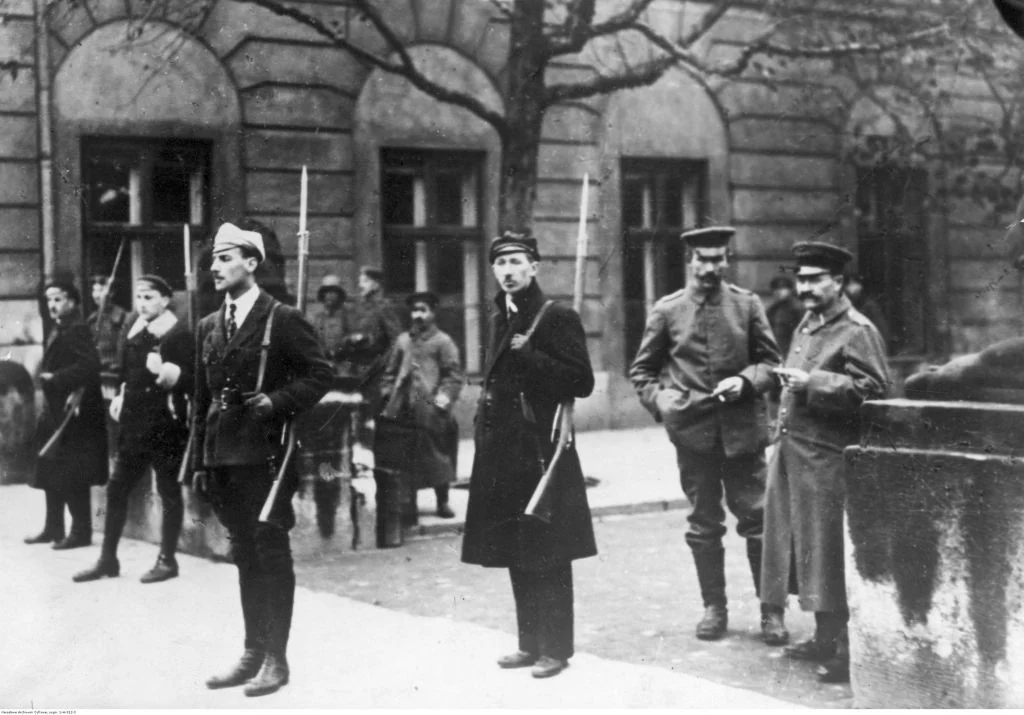
Warsaw, November 1918. The first days of rebuilding the independent Polish state.
The reborn Polish-Lithuanian Commonwealth inherited not only three different administrative and legal systems, but also a divided economy. Unifying these areas was a huge undertaking. Its own currency was to be one of the foundations of the new state, but its introduction took time.
Interestingly, the Polish zloty might not have been called zloty at all.
On February 5, 1919, Józef Piłsudski signed a decree providing that the new monetary unit would be called “lech”. Other proposals were also considered, including “piast”, “pol” and “sarmata”. Finally, on February 28, 1919, the Legislative Sejm decided to adopt the historical name “złoty”, divided into 100 groszy.
The costs of rebuilding the country, war expenses and budget difficulties contributed to a sharp decline in the value of the Polish mark. In 1923, inflation turned into hyperinflation, and money lost its purchasing power faster and faster.
Władysław Grabski’s reform of 1924 was intended to restore confidence in the Polish currency. The Bank of Poland was established, the zloty based on the gold parity was introduced and the exchange rate was set at 1.8 million Polish marks for one zloty.

This number clearly shows the scale of the crisis the young country was facing.
Independence regained in 1918 did not yet mean economic stability. It had to be worked out, sometimes at the cost of very difficult decisions.

Political freedom and financial freedom are not the same thing
The history of the Polish currency leads to broader reflection. State independence provides the nation with the ability to independently decide its own fate, but does not automatically guarantee prosperity, stable prices or security of savings.
Poles have experienced this many times. First, during the economic crises of the Second Polish Republic, then during the war and occupation, and decades later also during inflation and the economic collapse of the twilight years of the Polish People’s Republic.
Each of these experiences had different causes and consequences. However, what they had in common was that political decisions, conflicts and the state of the economy directly influenced the everyday lives of citizens and the value of the money they had.
This is where the interesting Bitcoin context comes into play.
The proposed solution was based on an unusual assumption: the possibility of transferring value does not have to depend on a bank or a central operator, and the rules for issuing money can be defined in advance in the protocol. In the case of Bitcoin, this means, among other things, a supply limit of less than 21 million BTC.
There is a certain historical paradox here. After November 11, 1918, Poland had to build institutions that would ensure the credibility of its currency. Bitcoin was created as an attempt to create money that does not require trust in a single issuing institution.
These are two completely different approaches, arising from different circumstances. However, they raise a similar question: who should set the rules of the monetary system and what makes people trust these rules?

Bitcoin will not replace the state. However, it can expand the scope of individual freedom
Combining Independence Day with Bitcoin requires some caution. The fight for the rebirth of Poland, paid for with the suffering and lives of many generations, is not comparable to the creation of new financial technology.
There is also no reason to contrast Polish statehood and Bitcoin. An efficient state, independent courts, security of citizens and a stable economic system remain values that no cryptocurrency can replace.
Bitcoin, however, brings something to the contemporary discussion about freedom that we have not had in this form before. The ability to independently store and transfer digital assets without the need to use a traditional financial intermediary.
For a resident of a stable, democratic country, it may be, above all, an additional choice. For a person living in a country with restrictive capital controls, an unstable currency or limited access to banking, the importance of such a solution may be much greater.
This independence should not be idealized. Bitcoin remains a highly volatile asset, and storing private keys yourself involves liability and the risk of irreversible loss of funds. Its availability also depends on the technical infrastructure, and its use does not exempt you from compliance with the law.
Financial freedom is not about owning a specific asset. What is more important is the ability to consciously choose how to save, invest and store assets. Bitcoin may be one such choice, but it is certainly not the only one.

The most important lesson of independence
What is particularly moving in the celebration of November 11 is how many generations of Poles worked to regain statehood, even though they were not sure whether they would see it in their lifetime.
And when we finally managed to regain independence, it turned out that Poland faced another huge challenge: creating a state that would be able to maintain this freedom.
Your own money was only part of this effort, but a very important part. Without stable finances, it is difficult to build a strong economy, ensure security and realize society’s long-term ambitions.
Today we live in a reality in which we can use the Polish zloty, euro, dollar, gold or Bitcoin. We can also discuss the advantages and weaknesses of each of these solutions. The very ability to make such choices, engage in open debate and develop one’s own business ventures is one of the achievements of a free society.
Perhaps that is why on November 11 it is worth thinking not only about freedom as a historic victory, but also about the responsibility for maintaining it every day. For institutions, economy, law and mutual trust, without which it is difficult to imagine a well-functioning state.
Independence was not given to us once and for all. It is not enough to regain it, you also need to know how to use it wisely.
And although almost the entire world around us has changed since November 11, 1918, this lesson remains valid.
Not only in relation to money.