

Four banks will re-check rejected claims. Who can get a refund?

  • ING Bank Śląski, Nest Bank, Plus Bank and Bank Ochrony Środowiska are to reconsider some of the rejected complaints regarding unauthorized transactions.
  • Using a PIN or confirming an operation in the app may demonstrate that the transaction has been authenticated. By itself, it does not prove that the customer has agreed to a specific payment.
  • Former clients affected by the decisions will receive instructions on how to submit an application. At ING, this also applies to some current customers.

On November 3, the President of the Office of Competition and Consumer Protection issued four decisions regarding complaints about unauthorized payments. ING Bank Śląski, Nest Bank, Plus Bank and Bank Ochrony Środowiska are to change their procedures and resume some of the cases that ended with a refusal. If the re-analysis shows that the customer is due a refund, the bank will return the money. The Office of Competition and Consumer Protection’s announcement was published on November 4.

Why should banks change their procedures?

According to the office, banks considered correct authentication as proof of the customer’s consent to payment. Meanwhile, the PIN can also be entered by a person who obtained it without the consent of the card owner. It is the bank that must prove that the customer authorized the transaction. The Office of Competition and Consumer Protection also questioned ING’s responses suggesting that the client bears full responsibility and can only recover the funds with the help of law enforcement authorities.

In the case of Plus Bank, the office questioned the information that a card payment reported after 120 days cannot be considered unauthorized and that a maximum of 15 transactions can be reported. These restrictions were related to the chargeback procedure. According to the decision for Plus Bank, they cannot be used as statutory limits for complaints.

The President of the Office of Competition and Consumer Protection, Tomasz Chróstny, emphasized: “The bank’s mere demonstration that the transaction has been correctly authenticated is not enough to refuse to refund the money.”

Which complaints will banks check again?

Banks are to implement new procedures within six months of the decision becoming final. According to the statement, the reanalysis covers some of the refusals from November 16, 2022. In matters eligible for review at the bank’s initiative, reasonable refunds are to be made no later than December 31, 2027.

At ING, the automatic mode covers eligible applications from existing customers submitted from November 16, 2022 to August 16, 2026. If the bank refused after August 16, until new procedures are implemented, the case may be re-examined upon request, according to the decision for ING. The bank is to notify interested parties about the method of submitting it.

Former customers whose complaints submitted after November 15, 2022 were included in the decisions will receive individual notification. The request is granted three months from receipt of the information. The bank is to consider it within one month of receipt. The deadlines for sending notifications depend on the bank and customer group.

Information about the decisions will also appear on banks’ websites and in their applications. Banks are to submit reports to the Office of Competition and Consumer Protection by April 30, 2028. Previously, the office issued similar decisions regarding Alior Bank, mBank, BNP Paribas and Bank Millennium.
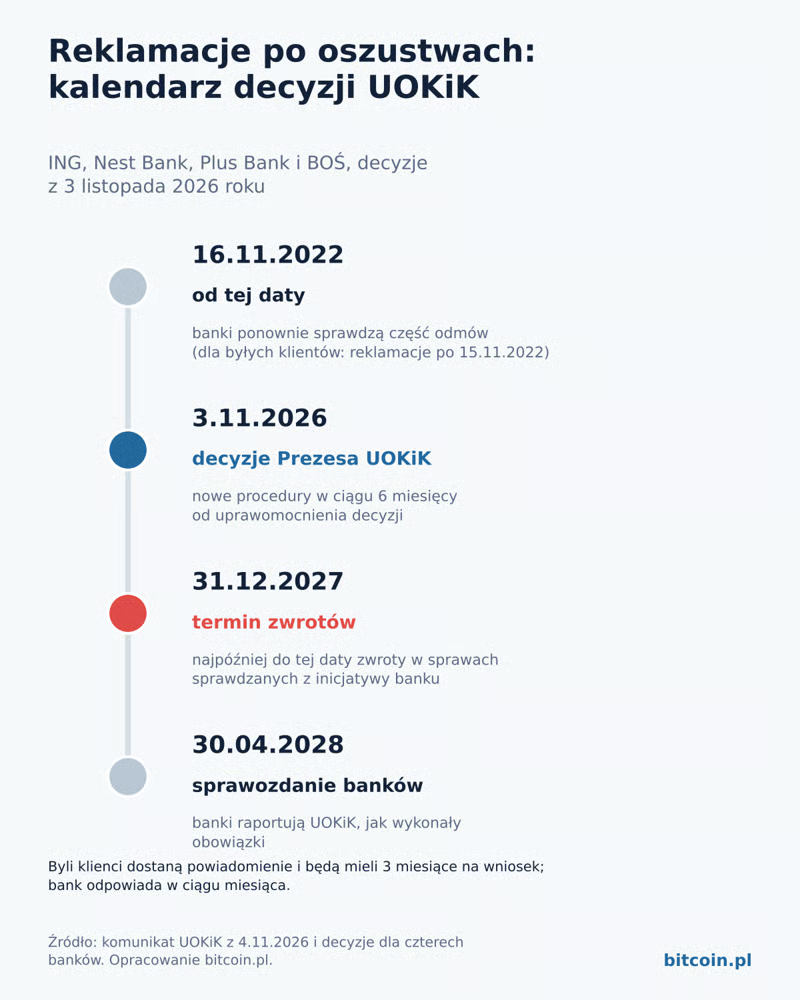

Timeline of the Office of Competition and Consumer Protection's decisions regarding ING, Nest Bank, Plus Bank and BOŚ: from November 16, 2022, the period for re-checking refusals, November 3, 2026, decisions, December 31, 2027, the deadline for returns, April 30, 2028, banks' reports

How many complaints will the decisions cover?

The Office of Competition and Consumer Protection did not provide the number of cases or the total amount of refunds in its announcement. The date on which each decision becomes final is important for the deadlines counted from that moment. The decisions also include calendar dates, including: December 31, 2027 for returns in the manner described above.

When should the bank return the money?

After detecting an unauthorized transaction or receiving a report, the bank is generally obliged to return the money immediately, no later than the end of the next business day. It may withhold a refund if it has reasonable and documented grounds to suspect fraud on the part of the customer and will notify law enforcement authorities in writing. Report the transaction as soon as you notice it. The Payment Services Act generally provides for 13 months from the date of debiting the account for reporting, with the exception of, among others, situations where the bank did not provide the required information about the operation.

In case C-70/25, the Court of Justice of the EU separated the obligation to pay quickly from liability for loss. The suspicion of gross negligence on the part of the customer does not in itself allow the refund to be withheld. The bank may later seek reimbursement of the loss from the customer if it proves that it was the result of intentional action or breach of duty due to gross negligence. This is how the Court’s communiqué sums up the judgment.

If a fraudster made a transfer using stolen data, for example through phishing, report the transaction without your consent to the bank. If you yourself ordered a specific transfer for a fraudulent investment, describe to the bank how the fraud occurred and ask whether it is possible to keep or recover the funds. In both cases, what matters is the course of the specific operation. The confirmation entry in the application itself does not determine whether the customer agreed to the transfer as made.

Are you reading us? Add bitcoin.pl to your preferred sources on Google

What does this mean to you

If the bank has rejected your claim, keep a record of the report, the bank’s response and the dates of the correspondence. If your case may be subject to review, please check your bank’s procedure. When you receive an individual notification that you need to submit an application, keep an eye on the deadline indicated in the message. Report a new unauthorized payment immediately, regardless of the review of older cases.

If the bank alleges gross negligence, ask for a written justification and evidence. You can ask for help from the municipal or district consumer ombudsman or call the consumer hotline at 801 440 220 or 222 66 76 76. How fraudsters reach Poles through advertising on social media is described in the text about the Meta case.