
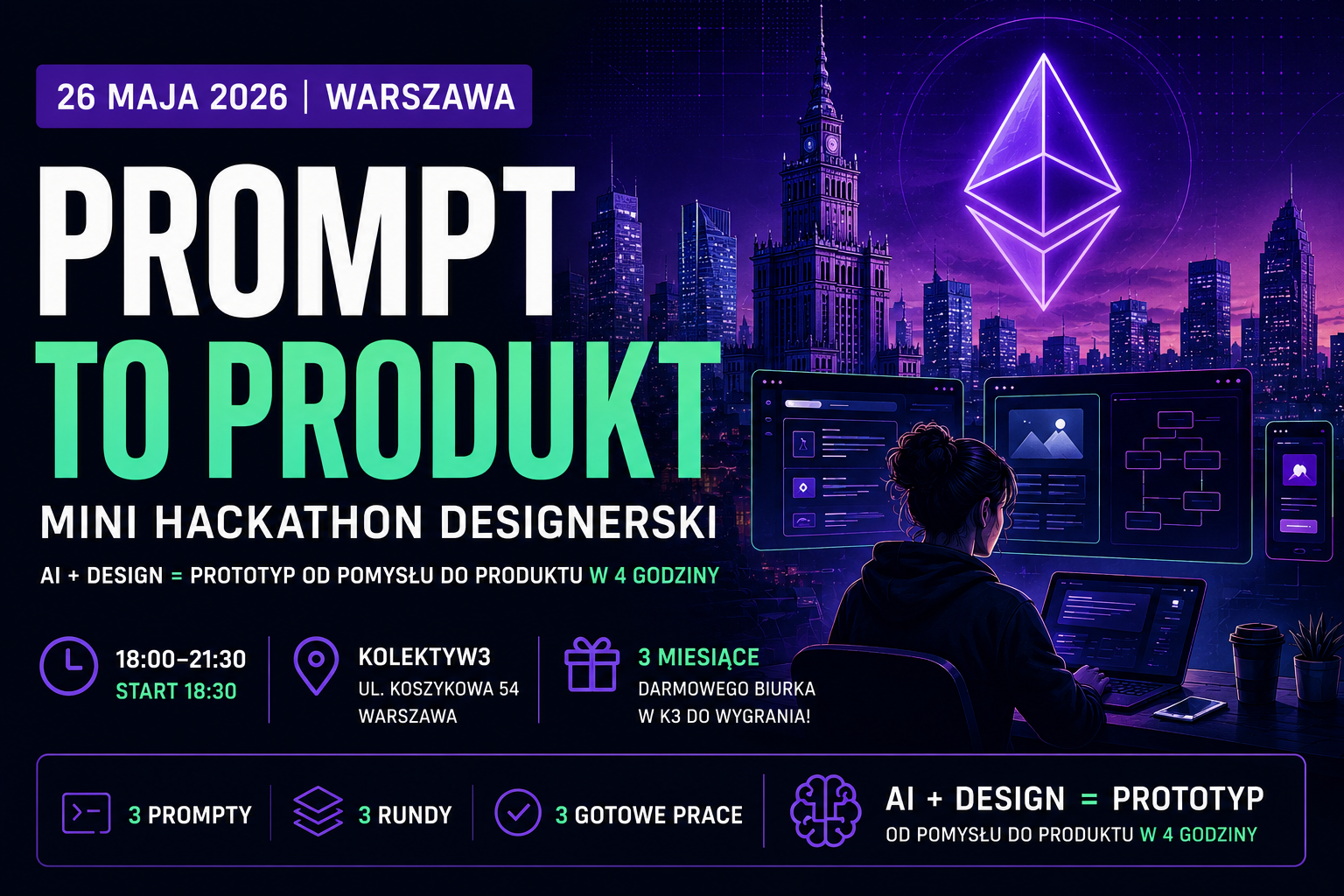
- Already on Tuesday, May 26an event will be held at Kolektyw3 in Warsaw “K3 Sessions: Prompt to product. Mini design hackathon”organized as part of the ETHWarsaw calendar.
- Participants will have a few hours to create ready-made projects based on prompts, using tools such as Lovable, Cursor, Figma or classic design methods.
- The event shows how quickly the work of designers, founders and product creators is changing when AI ceases to be just an addition and becomes part of the building process.
AI is entering product design
Until recently, creating an application prototype required a team: a product manager, a designer, a programmer, and often also a copywriter and a user research person. Today, part of this process can be significantly shortened thanks to AI tools. This does not mean that a good product “makes itself”. However, the starting point is changing.
Instead of starting with an empty Figma file or an hour-long discussion of features, a creator can start with a prompt, a well-described command for the AI tool. Such a prompt can help build the application structure, generate the first view, propose a user flow or prepare a simple prototype. This is what the ETHWarsaw event is all about: moving quickly from an idea to something you can see, click and rate.
The organizers describe the format clearly: four hours, three rounds, three prompts and three completed works. Each round will be preceded by a short, 10-minute show from the Properly team, which will present its own process of working with AI in design. After such an introduction, participants will be given 15 minutes to prepare their own version of the task.
Three rounds: structure, visual layer and “delight”
The hackathon was divided into three parts. The first one concerns structuresi.e. how to plan the application before specific screens are created. In practice, it’s about product architecture: what the user sees first, what options he has, where he goes next and what should be obvious to him without additional explanations.
The second round focuses on visual layer. This is the stage where a simple sketch or rough layout begins to resemble a product ready to be shown to users. In the world of applications and Web3, this is very important. Even the best idea can be rejected if the interface is chaotic, unreadable or too technical.
The third round is called Delight. The organizers describe it as “the magic 5% that makes a difference and stays in your mind.” It’s about the details that make the product not only correct, but also pleasant to use. It could be an animation, a micro-interaction, a well-written message, a clever simplification of a process, or an element that makes the user feel like someone has really thought about their experience.
For designers, programmers and people with a good eye
The event is not only addressed to professional designers. According to the organizers’ description, participation is open to both experienced designers and programmers who want to test their sense of interface, as well as beginners who have a good eye for digital products.
This is important because AI is increasingly blurring the boundaries between roles in technology teams. Today, a programmer can prepare a visual prototype faster. The designer can better understand the application logic. The founder can test the first version of the idea on his own before inviting a larger team to the project.
Participants can use any tools. The organizers list, among others: Lovable, Cursor and Figmabut they also allow working on a piece of paper. This clearly shows the meaning of the event. It’s not about blindly using AI, but about seeing how different methods can help with rapid product thinking.
Kolektyw3 as a meeting place for builders
This is a broader trend. Conferences and large hackathons are still important, but smaller, regular meetings where people actually build, test and show off their projects are becoming more important. ETHWarsaw in its recent entry on Substack indicated that Kolektyw3 is to be a place for people looking for coworking, technical meetings and contact with other creators.
From this perspective, “Prompt to Product” is not just a workshop about prompts. It is also a signal that the Polish Web3 and AI scene is increasingly moving towards practical construction. Less slides, more prototypes. Less debate about the potential of technology, more checking whether a specific idea can be turned into a working product.
What can you win and what does the agenda look like?
Participants will also receive a prize. There are prizes to be won 3 months of free space in the K3 office. For people who are working on their own product, this can be a real value: access to space, community and people who are at a similar stage of building.
The event agenda is as follows:
18:30: welcome, product brief and scoring rules
18:40: round 1: structure
19:15: round 2: visuals
19:50: round 3: delight
20:30: final, winner, summary and Q&A
20:45: networking
Why is this event important for the Web3 market?
For the crypto and Web3 community, such events are more important than it may seem. One of the biggest problems for the industry for years has not been the technology itself, but usability. Wallets, DeFi applications, onchain tools, dashboards, and protocols are often created by great engineers, but can be difficult for regular users.
AI can speed up this process, but it will not replace good thinking about the product. However, it can help you test variants faster, look for better interfaces and shorten the path from idea to prototype. In the Web3 world, where many projects compete for users’ attention, ease of use and good design can determine whether a product will reach beyond a narrow group of enthusiasts.