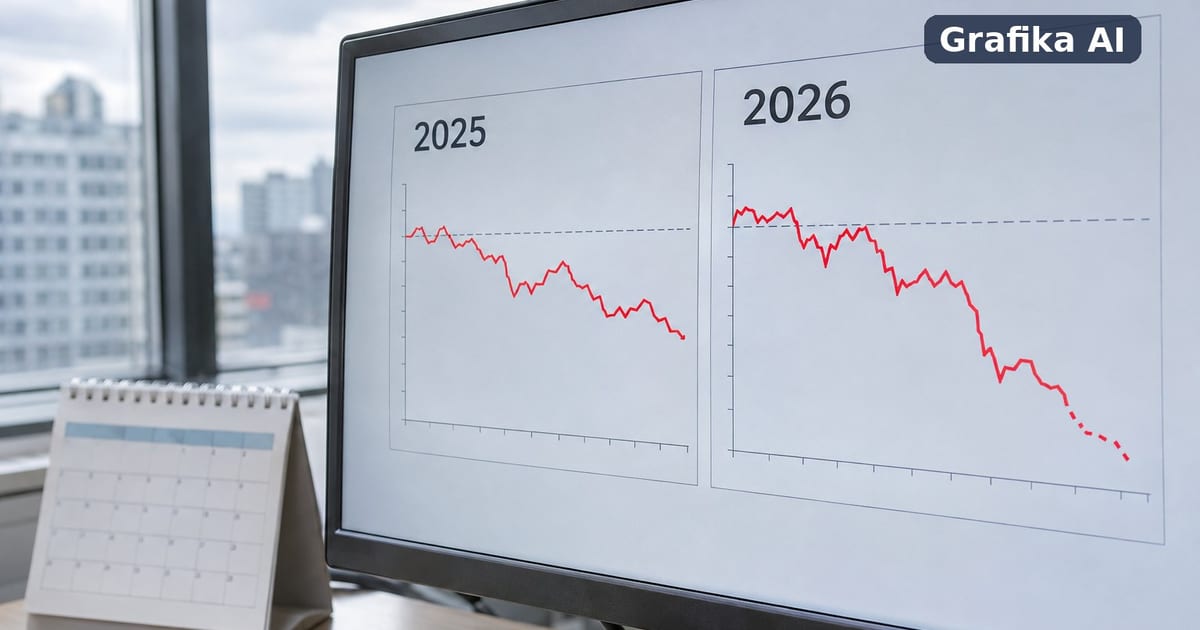
- Bitcoin ended 2025 down 6.3%. For 2026 to be bullish, it must close the year above about $87,517. On Saturday, November 14, it ended the day at around $63,821.
- At this price, an increase of approximately 37% is needed to make up for this year’s loss. There are seven weeks left until the end of the year.
- Since 2010, bitcoin hasn’t had two consecutive calendar years with a decline. The 2026 outcome remains open.
- The sell-off is accompanied by expectations of a Fed rate hike, outflows from ETFs, a shrinking supply of stablecoins and weakness in AI-related stocks.
At its closing price on Saturday, November 14, around $63,821, bitcoin was about 27% cheaper than at the end of 2025. If it does not make up for the loss by December 31, it will be the first time since 2010 that two consecutive calendar years will end in decline. There are seven weeks left until the end of 2026.
Which exactly would be a record
According to daily closes from Coin Metrics, bitcoin had four completed declining years: 2014 (−56.0%), 2018 (−73.5%), 2022 (−64.4%), and 2025 (−6.3%). After the first three, there was a rebound: 2015 brought 34%, 2019 about 94%, and 2023 about 155%. Whether it will be similar after 2025 will only be revealed at the end of December.
Bitcoin ended 2025 at around $87,517. It must be above this threshold on December 31 for this year’s result to be positive. At $63,821, this would require an increase of approximately 37.1%.
What’s weighing on Bitcoin?
The sell-off coincides with concerns about a rate increase in the US. According to BLS data from November 13, producer inflation was 6.5% year-over-year in October, the highest since November 2022. After hot data on October inflation, the market is increasingly pricing in a rate increase at the December Fed meeting, writes Wealth Professional. More expensive money tends to increase pressure on risky assets, but it does not allow the entire decline in bitcoin to be attributed to a single cause.
Shares of AI-related companies are also doing poorly. On Thursday, November 12, Jensen Huang resigned from Nvidia. On Tuesday, November 17, the company is scheduled to release results for the third quarter of fiscal year 2027, the first under the leadership of interim CEO Colette Kress.
Money is also flowing out of the funds. According to data from Farside Investors, from November 2 to November 13, U.S. spot bitcoin ETFs recorded approximately $2.35 billion in net outflows. IBIT BlackRock completed its eleventh consecutive session of outflows on November 13.
Lower liquidity may further intensify price movements. In Talos’ November 12 report, order book depths in select BTC spot markets were at their worst approximately one-third below the recent benchmark. This is about the value of orders close to the current price, which can accept larger sales without a sharp change in the price. The report also noted a partial depth recovery.
According to Glassnode, the stablecoin supply shrank by $14.2 billion in the 30 days to November 9, the fastest since June 2022. This is another sign of capital outflow from the cryptocurrency market.
Two years of decline do not mean the greatest loss
At a price of $63,821, the total change since the end of 2024 is approximately −32%. This is a smaller decline than −73.5% in 2018 alone or −64.4% in 2022. The result for the two years takes into account their subsequent rates of return, instead of adding them together.
The loss calculated from the peak looks different. Since the record closing on October 6, 2025, approximately 124.8 thousand dollars, to this year’s low on June 30, approximately 58.5 thousand. dollars, bitcoin lost 53% of its value, according to the daily closes of Coin Metrics. The annual rate of return therefore does not show the entire path the price has traveled.
2025 was also the first downward calendar year immediately following the halving year. The years 2013, 2017 and 2021 ended with growth. Some analysts see this as the end of the four-year cycle, others as its change. None of these ratings determines further quotations.
What does this mean to you
The result of the entire year will only be determined by the bitcoin price at the end of December 31, which was approximately USD 87,517. The fact that previously a down year was followed by an up year is not a rule on which a plan can be built. If you are buying bitcoin or considering selling it, take into account that with weaker market liquidity, the price may fluctuate significantly in both directions until the end of the year. How long did the previous declines last and how deep were they, as well as what caused them, is compared in the guide to why bitcoin is falling.