
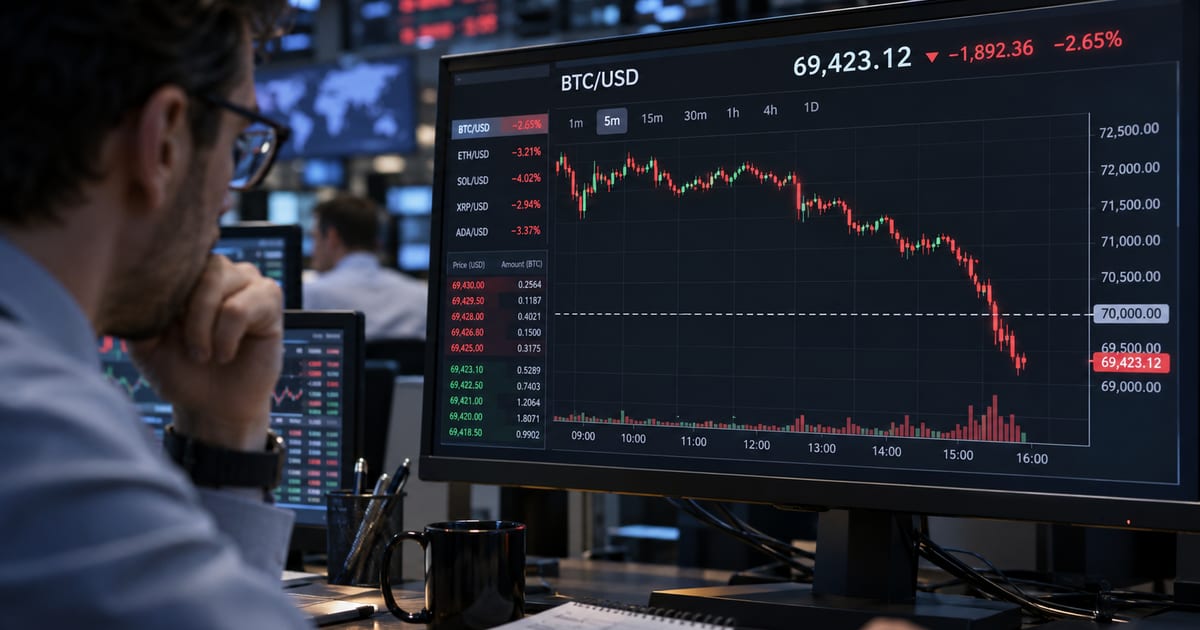
Bitcoin fell to around $67,500 on Friday, November 13, hitting its lowest levels since August. After 2:30 p.m., the market learned more data on inflation in the US, and the latest ETF statistics confirmed the continuing advantage of capital outflows. Although the BTC rate has recovered some of its losses, investors still face the risk of further depreciation.
On November 4, Bitcoin reached USD 81,196 on Binance. Today’s low of $67,568 represents a decline of approximately 16.8% in nine days. The subsequent rebound to around USD 69,700 shows that buyers are trying to take advantage of the sell-off, but so far the bitcoin price has not regained the USD 70,000 mark.

Why is the bitcoin price falling? ETFs, inflation and a wave of liquidations
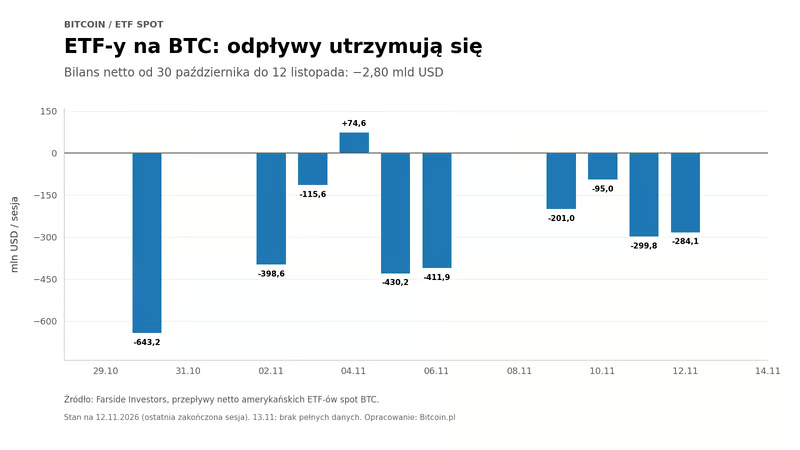
Outflows from ETFs exceeded USD 2.8 billion
The latest data from Farside Investors shows that on November 12, another USD 284.1 million net flowed out of US spot Bitcoin ETF funds. The largest negative flow was for BlackRock’s IBIT ($203.8 million), followed by Fidelity’s FBTC ($32.6 million).
It was the sixth session in a row with a negative balance. From November 5 to November 12, net outflows totaled USD 1.72 billion, while in the period from October 30 to November 12 they amounted to USD 2.80 billion. This is an important signal of weakening demand for exchange-traded products, although ETF flows are not the same as the total capital flowing into the Bitcoin market.
New inflation data in the USA. PPI increases by 6.5% per year
The PPI excluding food, energy and trade services increased by 0.5% month-on-month. The data therefore show a mixed picture: the main monthly reading was softer than expected, but cost pressures remain high.
This has implications for the Federal Reserve’s December decision. After earlier, higher-than-expected CPI data, investors began to take into account the possibility of a stronger tightening of monetary policy. Higher interest rates and a stronger dollar may limit interest in risky assets, including Bitcoin. However, today’s PPI report does not provide grounds to attribute to it the entire sell-off that began before the data was published.
Forced liquidations accelerated the decline
In CoinGlass’ morning rankings, the value of liquidated positions in the entire cryptocurrency market exceeded USD 1.6 billion in a moving 24-hour period. The vast majority were long positions, i.e. bets on price increases.
Leveraged position closures amplify declines because stock exchanges automatically reduce the exposure of investors whose collateral proves to be insufficient. As a result, one wave of sales may trigger another.
However, it is worth distinguishing between the nominal liquidation value and the actual lost capital. Moreover, their sum changes as the 24-hour measurement window is moved. In the CoinGlass reading from around 14:52 CET, the value of open BTC futures contracts was USD 48.42 billion, 5.51% less than the day before. This indicates a reduction in leverage, but does not yet confirm the end of the sell-off.
Nvidia and MSCI further worsened the mood
On November 12, Nvidia officially announced the departure of Jensen Huang as president. The current CFO, Colette Kress, took over as interim CEO. The event increased uncertainty around the US technology sector, with which Bitcoin often shows a positive correlation during periods of strong changes in risk appetite. NVIDIA Newsroom+1
Additionally, MSCI’s decision to remove Strategy from equity indices, effective after the close of trading on November 30, increased pressure on MSTR shares. This may prompt index-tracking funds to sell these shares, but does not automatically result in the sale of bitcoins accumulated by Strategy.

What’s next for Bitcoin? Three scenarios
Upside Scenario: Back to $72,000-$74,000
Neutral scenario: consolidation in the range of USD 67,500-71,500
Downside scenario: moving towards $65,000
A sustained break of the low near $67,500 would increase the risk of further sell-off. The next rough watch area would be $65,000. The implementation of this scenario could be supported by further outflows from ETFs, an increase in risk aversion and pressure on technology shares.
The levels listed are indicative analytical zones and not confirmed support levels or price predictions.
Three issues will be particularly important for investors now: whether ETFs will break the series of outflows, whether the decline in the number of open futures contracts will limit further liquidations and how expectations regarding US interest rates will change.
The next important event will be the publication of the US PCE index scheduled for November 25, followed by the Fed’s decision on interest rates on December 9. Especially the latter date may prove important for the future direction of the cryptocurrency market.