
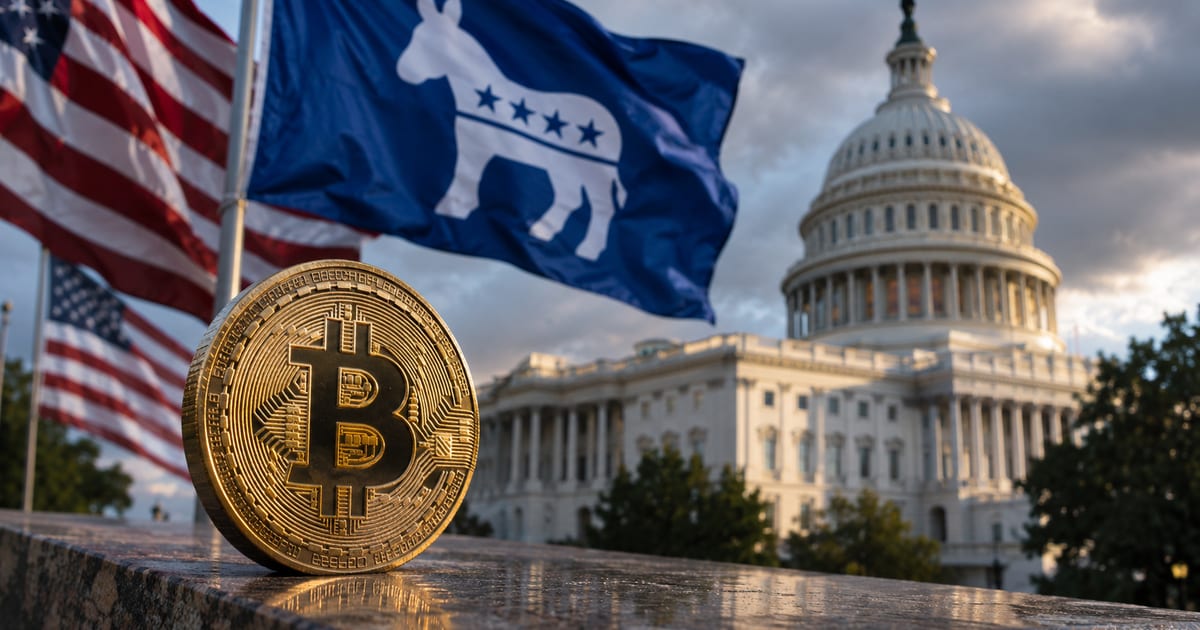
The victory of the Democrats in the US Congressional elections caused a nervous reaction in the cryptocurrency market. Bitcoin fell to around USD 75,600, but returned above USD 80,000 on the same day. The rebound looks impressive, although there is still a long way to make up for the losses from recent months. The further direction of the exchange rate may be determined primarily by interest rates in the US, capital flows to ETFs and political negotiations in Washington.
Despite the improvement in sentiment, BTC remains approximately 36% below the historic high from October 2025, which is approximately 126.1-126.2 thousand depending on the source. USD. The post-election increase is therefore a rebound as part of a much broader correction.
Why didn’t the Democrats’ win stop Bitcoin’s rebound?
Donald Trump has spent the last two years presenting the United States as the future center of the global cryptocurrency market. His administration established a strategic Bitcoin reserve, and in July 2025, the president signed the GENIUS Act regulating stablecoins. The industry also counted on the quick adoption of the CLARITY Act, a project intended to define the principles of operation of the digital assets market and the division of competences between the SEC and the CFTC.
The future of this last act has become one of the most important political question marks. On September 15, the Senate failed to pass it through a procedural vote: 50 senators supported further work, 49 were against, and the required threshold was 60 votes. Some Republicans then joined Democrats who demanded, among other things, stronger protections against conflicts of interest. The new majority in Congress may demand further changes or block the project in its current form.
However, the election result does not mean an automatic reversal of all existing regulations. Trump remains in the White House, retains the right to veto, and some Democratic politicians also support the development of the industry. Bitcoin itself is also in a different position than most altcoins: American spot BTC ETFs have been operating since 2024, and its legal situation is more established.
There is therefore room for a rebound on the market after the initial sell-off. The clear election result reduced short-term political uncertainty, and as the sentiment on the US stock markets improved, some investors returned to shopping. However, attributing the entire increase to the Democratic victory alone would be an exaggeration.
Over a billion dollars flowed out of ETFs. In addition, there was an attack on Binance
In the IBIT fund managed by BlackRock alone, on November 2, the outflow was USD 405.3 million, and a day later it was USD 95 million. Such flows do not determine the direction of the price on the next day, but show that some large investors are limiting their exposure to the market. A return to regular inflows to funds would be necessary for a more lasting recovery.

The Fed may have a greater influence on the BTC rate than the balance of power in Congress
In October, the US Federal Reserve kept interest rates within a range 3.75–4.00%. The decision was made by a vote of 10 to 2; two committee members favored a 25 basis point increase. September CPI inflation in the US was 3.7% year-on-year, and core inflation was 2.6%. These are data that make it difficult to quickly return to cheaper money.
This has specific meaning for Bitcoin. High yields on safer financial instruments reduce the attractiveness of highly volatile investments. The cryptocurrency market also reacts to the situation on Wall Street, the availability of capital and expectations regarding the Fed’s next moves.
Before the end of the year, investors will learn the American labor market report for October (November 6), the CPI inflation reading for October (November 10) and the Fed’s decision after the meeting scheduled for December 8-9. Particularly important will be the answer to the question whether the central bank will maintain its restrictive attitude also at the beginning of 2027.

Where could Bitcoin be by the end of 2026?
After returning above USD 80,000, the first major barrier remains the region $81,300. According to a Reuters technical analysis from November 4, there was a 30-day moving average there. Breaking it would increase the chance of testing the October highs above $84,800 and then trying to regain $90,000.
In a favorable scenario, the end of the year could bring a return to around USD 85,000-90,000. However, this would require improved flows to ETFs and macroeconomic data that would reduce fears of further interest rate increases. Without these signals, the rate may be stuck in a wide range around $75,000-$85,000 for the next few weeks.
On the downside, investors should watch around USD 75,000-75,600, where the post-election sell-off stopped. Losing this area would increase the risk of a drop to around $73,200 and, in the event of a stronger sell-off, back towards $62,000. These are indicative levels resulting from the November 4 chart, not a forecast of guaranteed price movement.
Two issues will be key in 2027: how the new Congress manages relations with the Trump administration and the Fed’s monetary policy. The prolonged dispute over regulations may weaken sentiment towards the sector, especially towards altcoins. However, if inflation starts to subside and ETFs start attracting capital again, BTC returning to $100,000 in the first half of 2027 will remain a realistic scenario. From around $80,300, this would require an increase of nearly 25%.
For now, the November rebound has improved the short-term market picture, but it does not mean the end of the multi-month correction. The first test for buyers will be to stay above $80,000 and break through the $81,300-$85,000 zone. Equally important will be the upcoming inflation data and whether institutional investors will return to buying Bitcoin.