
In the cryptocurrency industry, choosing a safe exchange is not only a matter of commissions, trading pairs or convenience. It’s a decision about where your assets will be stored, how they are protected, and whether the platform provides enough transparency for you to verify its claims.
Here’s a practical step-by-step guide to choosing a safe cryptocurrency exchange.
Step 1: Check the Proof of Reserves
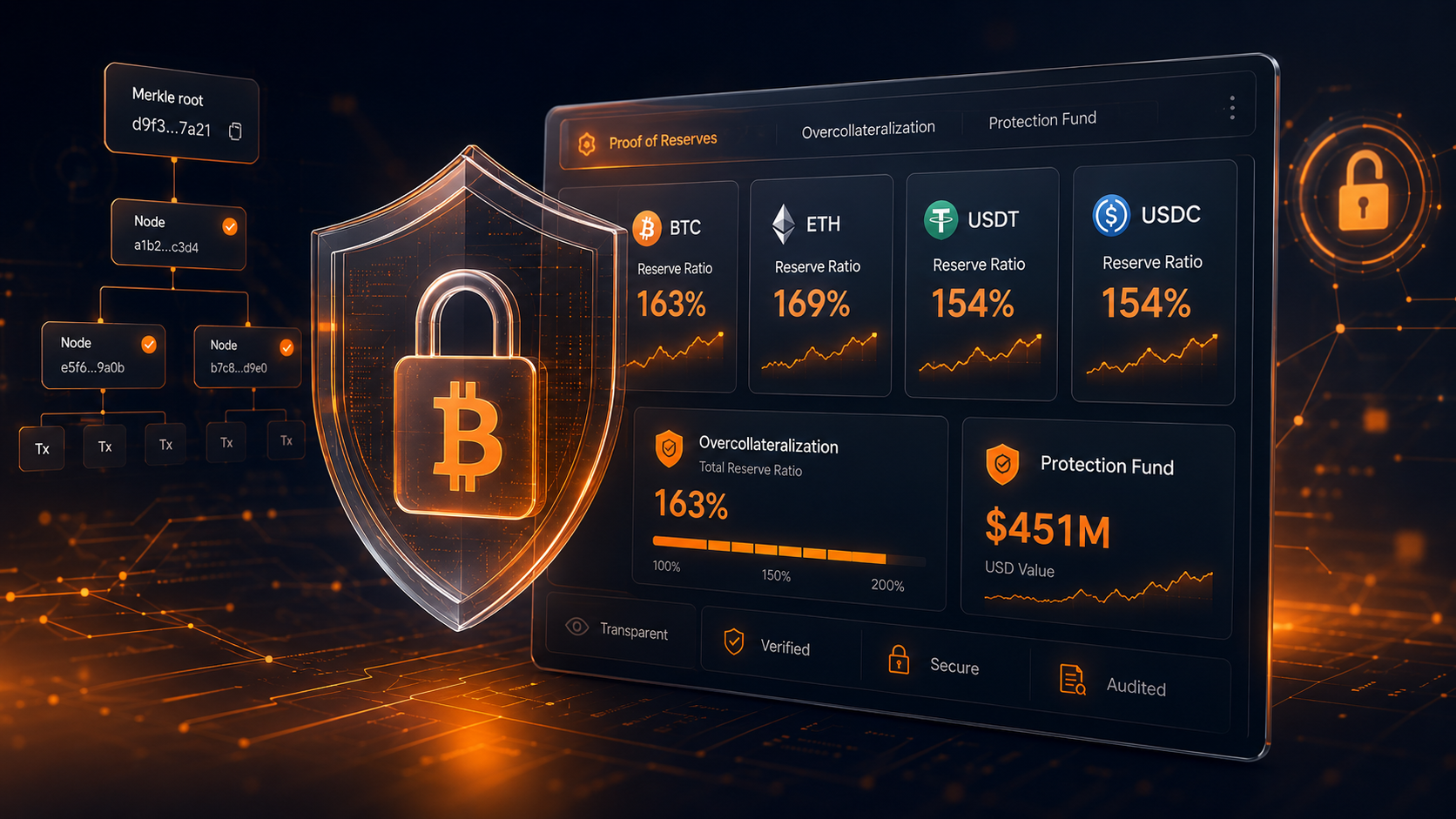
Let’s start with the “Proof of Reserves” – a document showing whether the exchange has enough funds to cover users’ balances. On the Bitget platform, “Proof of Reserves” is published monthly, and reserve ratios remain well above 100%. At the beginning of 2026, Bitget reported reserve ratios of:
- 163% in January 2026
- 169% in February 2026
- 154% in March 2026
A ratio above 100% means that the platform has more assets than the total funds deposited by users, which is a key indicator of financial health.
How to check it on Bitget:
- Open the “Proof of Reserves” page
- Select the latest monthly report
- Check your total reserve ratio
- Check coverage of major assets (BTC, ETH, USDT, USDC)
Step 2: Check your account balance using the Merkle tree
Proof of Reserves becomes much more important when users can verify their funds themselves. Bitget uses Merkle tree verification, which allows users to confirm that their balance has been included in the reserve summary without having to disclose personal information.
To put it simply:
- Your balance is converted into a secure string (hash)
- This string becomes part of a larger data set
- The system creates a Merkle tree
- You can check whether your data has been included using the cryptographic path
How to check it on Bitget:
- Log in to your Bitget account
- Go to the Proof of Reserves / Audit section
- Find your Merkle hash (verification ID)
- Use the provided verification tool
- Check if your data matches the Merkle root
If the verification is successful, your funds have been included in the official reserve report. Put simply, a Merkle tree acts as a tamper-proof system that allows each user to self-certify that measures have been taken into account, making transparency something practical and not just an empty buzzword.
Step 3: Check the status of the protection fund
In addition to reserves, a reliable exchange should provide additional safeguards in case of extreme situations. Bitget has a Protection Fund, the value of which in April 2026 was USD 451 million. This fund provides an additional layer of security in the event of unforeseen events such as cyberattacks.
What to pay attention to:
- Publicly disclosed value of the fund
- Transparent wallet addresses or reporting
- Clear purpose (user protection, not just marketing)
The existence of a dedicated fund of significant value proves that the platform is prepared not only for normal operations, but also for crisis situations.
Step 4: Go beyond reserves
A safe exchange combines transparency with a solid infrastructure.
When assessing the platform, you should pay attention to:
- Managing cold and hot wallets
- Real-time risk monitoring
- Payment security systems
- Account-level security tools (2FA, anti-phishing)
Bitget combines these elements with its reserve confirmation system and protection fund, thus creating a complete security system.
Step 5: Verify transparency
Security is not a one-time activity, but a continuous process.
A trustworthy exchange should:
- Regularly (monthly) publish confirmations of reserves
- Maintain consistent reserve ratios above 100%
- Provide user-level verification tools
- Provide easy access to data
Transparency should be lasting and predictable.
Step 6: Pay attention to the warning signs
Be careful with exchanges that:
- They do not publish evidence of reserves
- They do not offer Merkle tree verification
- They do not enable users to verify account balances
- They hide reserve ratios
- They lack additional security mechanisms
If verification is difficult or impossible, users must rely solely on trust.
Frequently asked questions
Is the cryptocurrency exchange safe?
Nowadays, popular platforms are much safer. Proof of reserves, margin funds, offline storage and regulatory licenses are now essential requirements. Bitget has a security fund of over $400 million (stored in 6,500 BTC, verifiable on the blockchain) with no security breaches since its inception in 2018. No platform is risk-free; always use two-factor authentication (2FA) and consider self-custody for long-term investments.
Is it safe to store cryptocurrencies on an exchange?
For people who value convenience or do not have technical knowledge, exchanges that have verified reserves, strictly comply with regulations and offer comprehensive insurance mechanisms are a good solution. However, self-custody wallets completely eliminate counterparty risk because users directly control private keys without relying on the exchange’s solvency. It should not be forgotten that self-custody comes with personal responsibility for security, including key management, backup procedures and protection against phishing attacks. For users who are comfortable with technical requirements, self-custody provides maximum security.
Which cryptocurrency exchange is the most trusted?
Choosing a trusted cryptocurrency exchange requires a systematic assessment in terms of security infrastructure, regulatory compliance, fee structure, range of assets offered and operational transparency. Platforms like Coinbase, Binance, and Bitget offer different advantages depending on user priorities: Coinbase emphasizes regulatory transparency and a user-friendly interface, Binance provides high liquidity and a rich feature set, and Bitget offers competitive fees and a wide selection of assets. Kraken and Bitpanda serve specific market segments, relying on strong regional regulatory foundations. There is no single platform that would suit all users, and the optimal choice of exchange depends on individual trading preferences or selected assets.
Which cryptocurrency exchange meets legislative standards?
A reliable cryptocurrency exchange is one that is secure, transparent, and operates under clear compliance standards. Famous examples include Bitget, Kraken, Coinbase, and Binance. The rule is simple: a reliable exchange is one that can be verified for security and transparency, and not just rely on its reputation. To verify that a platform has the appropriate credentials, you must verify regulatory registrations in official government databases, review the platform’s track record and management team transparency, seek independent security audits and reserve certifications, and review community feedback from multiple independent sources. Legitimized platforms provide clear information about the company, clear fee tables and responsive customer service channels. You should avoid platforms that promise guaranteed returns or pressure you to make instant deposits.