

- The US Department of Justice has charged the co-founder of a Florida company that promised ransomware victims that they would recover their data without paying a ransom.
- According to the indictment, the company did not have the technology to decrypt the data. Juan Ricardo Palacio Escobar was to secretly pay ransom to hackers in bitcoins and add a margin to customers.
- In a controlled FBI operation, an agent paid the company about $13,260, which gave about $6,000 to a “hacker” who was also an agent.
- Palacio was charged with three counts of fraud. Each is punishable by up to 20 years in prison.
An FBI agent who posed as a representative of the attacked company paid approximately $13,260 in June to recover encrypted data. The contractor promised help without paying any ransom. Meanwhile, he himself transferred about $6,000 in bitcoins to the “hacker”. This is according to the indictment announced by the US Department of Justice on November 25. The “hacker” was also an FBI agent.
The accused is 52-year-old Colombian Juan Ricardo Palacio Escobar, co-founder of a Florida company that offered help to ransomware victims. The prosecutor’s office did not provide the name of the company. The indictment was described earlier, on November 19, by 404 Media.
What the company promised and what it did according to the prosecutor’s office
The prosecutor’s office accuses Palacio of negotiating with hackers and paying them ransom in bitcoins without the customers’ knowledge, and billing his customers higher bills. He was supposed to keep the difference to himself. He used the money obtained in this way to buy several properties in Miami.
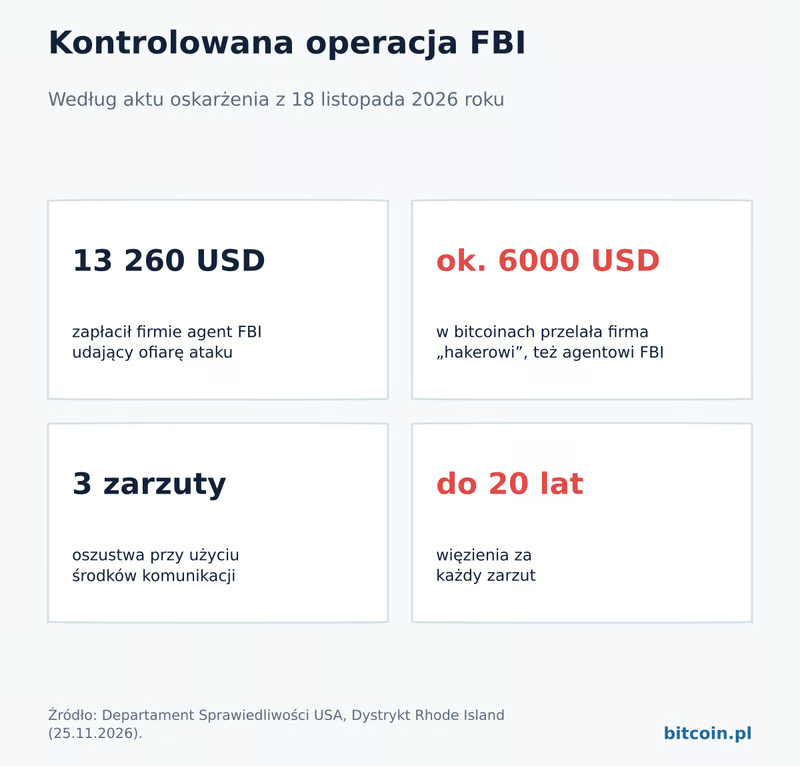
In an FBI operation, the company charged more than twice as much to the customer as it gave to the “hacker.” For every dollar of ransom, approximately $2.20 was paid by the customer.
How he got caught and what threatens him
The FBI operation took place in June. On October 22, agents detained Palacio in Las Vegas, from where he was transported to Rhode Island. On November 18, a grand jury indicted him on three counts of wire fraud. Each is punishable by up to 20 years in prison. As of November 20, Palacio has been held free of charge, under strict conditions set by the court.
There is no verdict yet. The release doesn’t say how many real customers the company served or how much they may have lost.

This is not the first company accused of such practice
What does this mean to you
Ransomware also attacks Polish companies that often use the help of external specialists. This case is taking place in the USA, but it shows what to ask before ordering “data recovery”.