AI promises progress, but could impact millions of workers
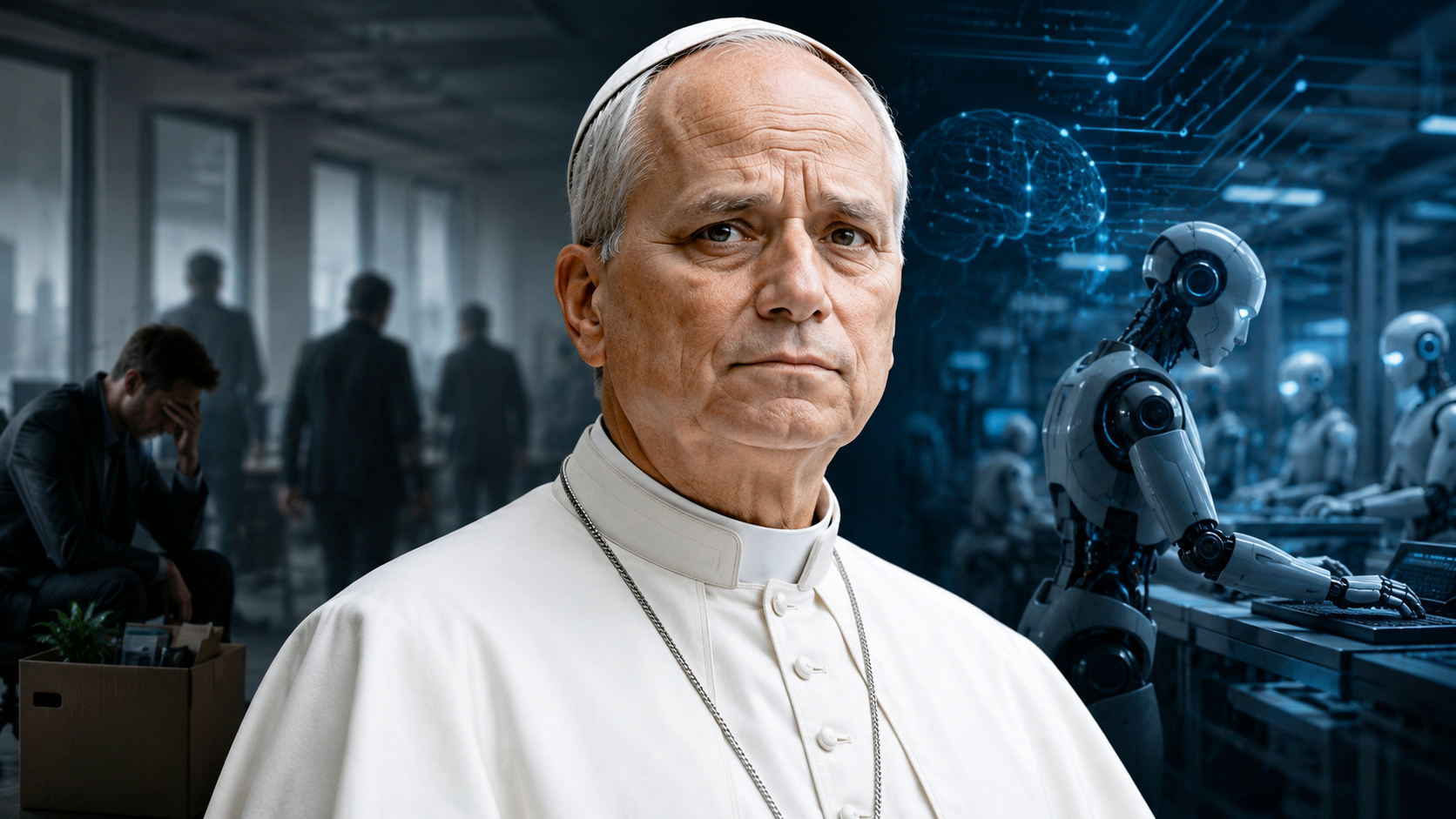
Artificial intelligence is increasingly presented as a technology that will increase productivity, free people from boring tasks and allow companies to operate faster. Pope Leo XIV, however, draws attention to the other side of this revolution.
This is one of the strongest parts of the documentary. The Pope does not talk about AI as an abstract tool of the future. It talks about the real labor market in which a person can be reduced to a cost, a process or an element of an optimization system.
Mass unemployment as a ‘social disaster’
The most important theme of the encyclical concerns the risk of large-scale unemployment. Leo XIV recalls the position of John Paul II, according to which unemployment is a “serious evil” and when it reaches mass proportions, it becomes a real social catastrophe requiring state responsibility.
In the context of AI, this diagnosis sounds particularly current. Pope notes that innovations are often implemented today mainly to reduce costs and increase profits. This can lead to a rapid shrinking of the number of available jobs, and the consequences do not end with unemployment statistics. They hit families, young people, local economies and entire communities.
In other words: AI is not just a topic for developers, investors and regulators. This is a topic for everyone who works, runs a business, raises children or wonders what the economy will look like in 5-10 years.
A human cannot become an addition to the algorithm
The Pope does not reject technology. It explicitly admits that AI can take over difficult, repetitive and dangerous tasks and thus support humans. However, the limit appears where technology begins to replace humans, not because it serves the common good, but because it allows us to cut costs faster.
Leo XIV writes that the protection of employment opportunities and the irreplaceable role of the human person should remain the principle. The pursuit of greater profits cannot justify decisions that systemically sacrifice jobs, because humans are an end, not a means to an end.
This is a very strong message towards the largest technology companies, corporations and investors. The Pope does not say: “don’t use AI.” Rather, he says: “don’t build an economy in which millions of people become redundant because the algorithm is cheaper.”
AI may deepen inequality
The encyclical also contains a warning against the new structure of inequality. According to the Pope, in many sectors we can already see a model in which a small group of highly specialized experts earn more and more, while a large part of employees experience employment instability and wage pressure.
This is a scenario well known from previous technological revolutions, but AI can accelerate it. Those who control the capital, data, models, computing infrastructure and distribution channels will gain the most. The greatest risk will be borne by people performing tasks that are easy to automate, but also by entire professional groups that until recently considered themselves relatively safe: office workers, analysts, copywriters, graphic designers, consultants, accountants, customer service workers and some programmers.
In this sense, the papal encyclical is not just a religious document. It is a voice in the global debate about who should pay the price of automation.
Who is responsible for the AI revolution?
One of the most important words in the entire document is responsibility. The Pope points out that it is not enough to react only when jobs have already disappeared. The transformation must be managed in advance. Each implementation of automation and AI should be linked to real actions protecting employment, retraining and employee participation in changes.
This means responsibility on several levels.
Companies should not measure success solely by margin growth and cost reduction. Countries cannot passively watch as entire industries are rebuilt without social protections. The education system must prepare people for a world in which frequent changes in competences will become the norm. Investors must take into account that “AI-first” cannot mean “human-last”.
Leo XIV also points out that proactive policies are needed to support training, career change and access to new competences. The cost of adaptation should not fall solely on a single employee.
Not just income, but the meaning of work
There is one more important thread. The Pope emphasizes that work is not just a way to earn money. It is also a source of dignity, relationships, responsibility, development and participation in social life. Therefore, a society in which only a small part of the population is employed may experience not only economic problems, but also a deeper cultural crisis.
This is particularly important in the discussion about basic income, automation and the “end of work”. Financial compensation alone may not be enough if millions of people lose their sense of agency, daily rhythm, professional identity and real influence on the world.
The Pope warns not only about poverty. He warns of a society in which technology advances faster than people’s ability to maintain meaning, dignity and participation.
Why is this important for the world of Bitcoin and Web3?
From the perspective of the cryptocurrency market and Web3, this encyclical is more important than it may seem. AI poses similar questions to Bitcoin, blockchain and decentralization: who controls the system, who decides the rules, who benefits and who bears the costs?
If the AI infrastructure is controlled by a few of the largest technology companies, there could be an even greater concentration of power than in the Web2 era. This time, what is at stake will not only be data, advertising and social platforms, but also work, knowledge, education, content production, business decisions and access to information.
Therefore, the Pope’s warning can also be read as a call to build a more open, transparent and socially responsible technology. One that does not replace humans for the sake of maximizing profit, but enhances their capabilities.
AI must serve humans, not the other way around
The most important idea of the encyclical is simple: artificial intelligence cannot become a new form of domination over humans. If AI is developed solely according to the logic of profit, competitive advantage and cost reduction, it may deepen inequality, increase unemployment and deprive many people of a sense of purpose.
Pope Leo XIV does not call for stopping technology. It calls for the development of AI to be subordinated to human dignity, the common good and responsibility for those who may be hit hardest by automation.
This makes it Magnifica Humanitas is not only a documentary about AI. It is a warning against an economy in which machines are becoming more and more productive and people are becoming less and less necessary.