
Key takeaways:
- Australian Cortical Labs sells CL1, a device in which approximately 200,000 live human neurons are connected to the control loop of the Doom game. The cells were grown from a piece of skin and can be kept alive for up to half a year.
- The reason anyone does this is because of electricity. The Frontier supercomputer cost $600 million and only in 2022 will it exceed the computing power of one human brain, while consuming a million times more energy.
- Thomas Hartung, who co-founded this field, says outright that it will take decades before such a system is as good as a mouse. The “neuro” sticker will appear on the equipment much earlier than neurons.
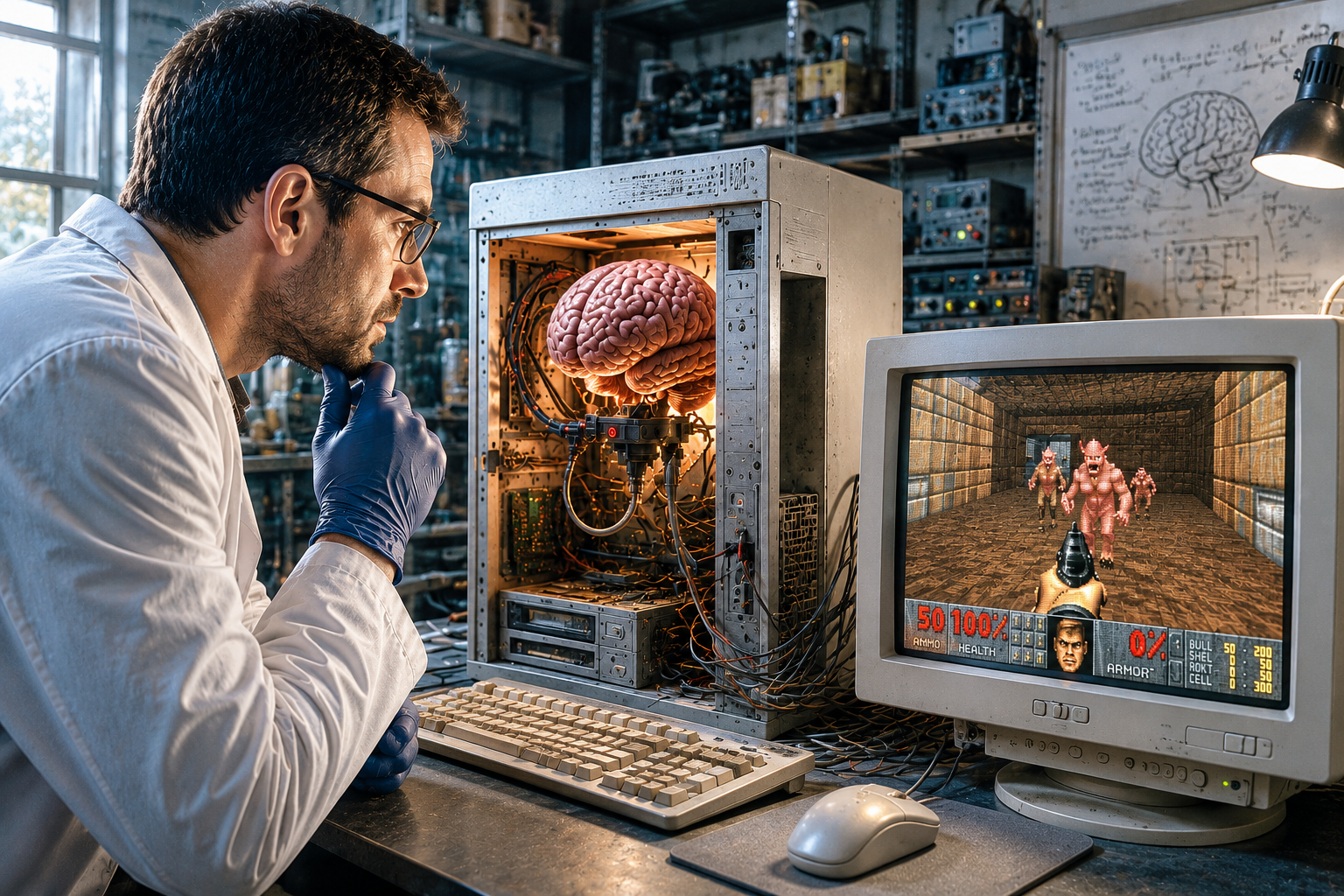
In the laboratory of the Australian company Cortical Labs, there is a computer with approximately 200,000 living human neurons. Doom game. The cells weren’t taken from anyone’s brain, they were grown from a piece of skin.
Today, the refrigerator, headphones and word processor are “AI-powered” because that label sells. The question is whether “neuron-driven” is in line for AI, and how much of it is already true.
The whole thing comes down to electricity
The computing power needed to train AI models is doubling every six months, and power plants cannot be built at this rate.
Biocomputers are a bet on the opposite scenario.
What did the leaked code show?
The architecture has three parts: a regular computer with a learning algorithm, a neuron culture, and a translator between them. Okay, but we still don’t know who controls it? When the author replaced the cell signal with random noise in the tests. Learning progress disappeared. Breeding does not play alone, but it is also not a decoration. CL1 does not replace either the processor or the graphics card.
How does it actually work for neurons to learn to play Doom? The basic features of neurons – self-organization and avoiding chaos – were taken and the system was built on this. Every time they took damage in Doom, or even lost in Pong, they received a chaotic signal that they perceived as a “threat”. Striving for the optimal state, they tried to avoid it, and in this way they learned. A familiar path of progress for evolution.
How many years separate us from the neuroprocessor?
Thomas Hartung of Johns Hopkins coined the term “organoid intelligence” and is seeking funding for this field. Nevertheless, he stated outright that it would take decades for such a system to match the mouse brain. And another few decades before something comparable to any computer would be created.
The scale explains this caution. Organoids from his laboratory have about 50,000 cells each, which is as large as the nervous system of a fruit fly. In addition, there is a barrier that is not a matter of schedule. The culture has no blood vessels, so it cannot be expanded arbitrarily, and the cells die within months anyway. There is also a geometry trap: to talk to cells, you need a flat grid of electrodes, and the brain is three-dimensional.
Now my thesis and I make it clear that this is speculation. The sticker will be years ahead of technology. “AI-powered” hit the kettles before anyone knew what was inside. I expect that “neuro” will follow the same path and will appear first in the names of accelerators without an ounce of living tissue.
A more likely scenario is more boring than replacing the processor in your laptop. These systems will become a laboratory tool for testing drugs, because this is the only application in which silicon is actually superior today.
Is there anyone in this pan?
The loudest thesis is that we have trapped a part of the human in the game. This is not clear from the data currently available to scientists. The popular description in which cells are “punished by chaos” is also humanizing.
We automatically assume that consciousness comes last, as a superstructure on top of intelligence. Neuropsychoanalyst Mark Solms argues the opposite: that feeling is older and stems from the drive to stay alive. If he were right, then when building systems whose only principle of operation is to silence disturbances, we would be messing with the first rung of this ladder, not the top. No one can decide this today, because there is no agreed method of measuring consciousness in this system. However, I believe this is an argument for setting the boundaries now, and not when the farms are ten times larger.
What does this mean for you?
If you are exposed to companies that make money on electricity starvation, then in the horizon of a few years, biocomputers are not a risk that needs to be valued. The bet is real, but it will be decided in decades, not quarters.
The thing worth watching isn’t another Doom video. It is the first published, standardized measurement of the energy consumption of an entire device for a specific task, compared to a graphics card. Until then, any number with the prefix “million times” describes the cells themselves, not the machine in which they sit.
Swiss FinalSpark, meanwhile, rents researchers access to its organoids via the Internet, with an interface in Python. Over the first three years of the project, over a thousand organoids were used and over 18 terabytes of data were recorded. Each of them was created from cells taken from a living person who still walks around the world and has no idea what his neuron was playing.