

Bitcoin is once again testing investor patience. On Friday, November 20, its price dropped to approximately USD 61,200, and the November discount is already approximately 20%. Fear dominates the market, but the latest data shows that despite the sell-off, institutional interest in Bitcoin has not disappeared.
At the beginning of November, over PLN 78,000 was paid for one Bitcoin. USD. Today, the world’s largest cryptocurrency is struggling to maintain the level of 60,000. dollars, and investors are wondering whether another wave of declines is ahead.
However, Friday’s weakness is not limited to cryptocurrencies. Technology stocks, especially those related to artificial intelligence, were also under pressure. On Thursday, the US Nasdaq Composite lost about 2.3%, and the sell-off then spread to Asian stock exchanges.
Why is Bitcoin falling? ETFs and liquidations are heating up the atmosphere
One of the most important factors putting pressure on the market is capital outflows from US ETFs investing directly in Bitcoin.
In addition, there are liquidations on the derivatives market. CoinGlass data shows that approximately $718.6 million worth of cryptocurrency positions were forcibly closed within 24 hours. As much as 86.2% of this amount was accounted for in long positions, i.e. bets on price increases.
At the same time, the total value of open positions in cryptocurrency futures contracts decreased by 2.5%, to approximately USD 109.9 billion. This is a sign of reducing financial leverage. While this process may deepen short-term declines, it also reduces some of the risk of further forced liquidations. CoinDesk
In November, U.S. Bitcoin ETFs recorded a total of approximately $3.47 billion in net outflows through November 19. However, it is worth looking at the fuller picture: since the launch of these funds in January 2024, their total balance of flows remains positive and amounts to approximately USD 53.6 billion. Farside Investors
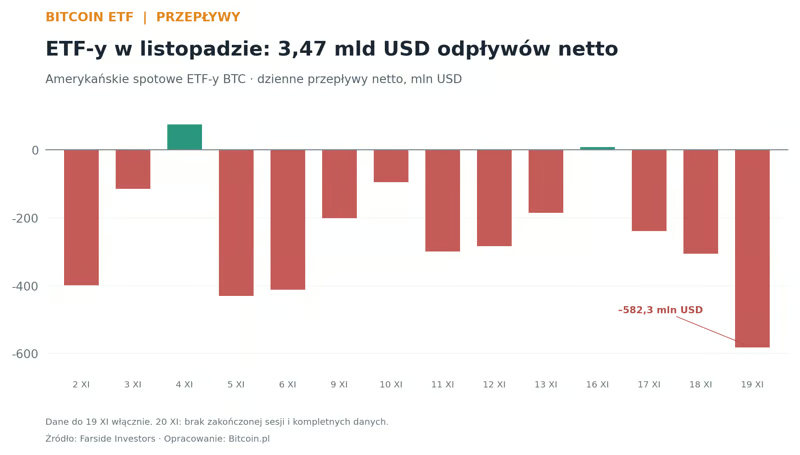
Chart: Daily net flows to US spot BTC ETFs, November 2-19, 2026. Source: Farside Investors. Developed by: Bitcoin.pl.
Why shouldn’t you write off Bitcoin just yet?
The combined positions of 2,166 reporting managers reached a record 356,491 BTC per fund exposure. Importantly, investment advisors and wealth management platforms have increased their resources for nine consecutive quarters. The data concern the end of September, so they do not determine what institutions did during the November sell-off. However, they show that the involvement of larger players is not limited to short-term speculation.
The history of Bitcoin itself also gives reasons for cautious optimism. At the end of June, its rate was approximately 58.6 thousand. USD, to exceed 83.5 thousand three months later. USD. This represents an increase of nearly 43% between the end of June and the end of September. Of course, the previous rebound does not guarantee that the current decline will end similarly.
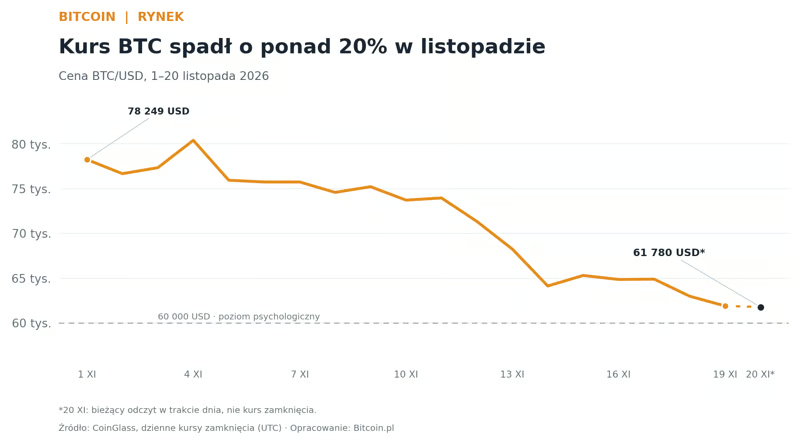
Chart: Bitcoin price from November 1 to November 20, 2026. Source: CoinGlass. Developed by: Bitcoin.pl.
The closest level that investors will pay attention to is 60,000. USD. Its loss could open the way to a retest of the July lows around 57.7 thousand. USD. In turn, a return above 65,000. USD, combined with limited outflows from ETFs and a calming situation on technology stock exchanges, would be the first signal of improved sentiment.
Finally, it is worth remembering that although Bitcoin has lost about half of its value since its historic peak in October 2025, its infrastructure and accessibility to investors are much more developed today than in previous cycles. The price may remain under pressure for a long time, but a decline in valuation does not automatically mean that interest in the asset itself disappears. The latest institutional data is a concrete example of this.