The US Federal Reserve left interest rates unchanged, but the decision was not unanimous. Two FOMC members supported the increase, and inflation in the US still remains well above the central bank’s target. For investors, the most important thing now is not what the Fed did in October, but whether it will decide to make another move in December.
The Federal Reserve concluded its October 28 meeting with a decision to keep the federal funds rate range unchanged 3.75–4.00%. This means a pause after the September increase of 25 basis points, the first since 2023. This time, ten members of the Federal Open Market Committee (FOMC) voted for leaving rates unchanged, while two people voted against. Lisa Cook and Beth Hammack argued for further increases in the cost of money. The vote result and the content of the October FOMC statement show that there is still no full agreement within the central bank as to the pace of the fight against inflation.
The pause itself was widely expected. According to a Reuters poll conducted on October 16-20, 94 out of 100 economists predicted that rates would remain unchanged. Therefore, the question of how long the Fed will maintain restrictive monetary policy and whether it will increase rates again in December is more important than today’s decision.
Inflation worries the Fed
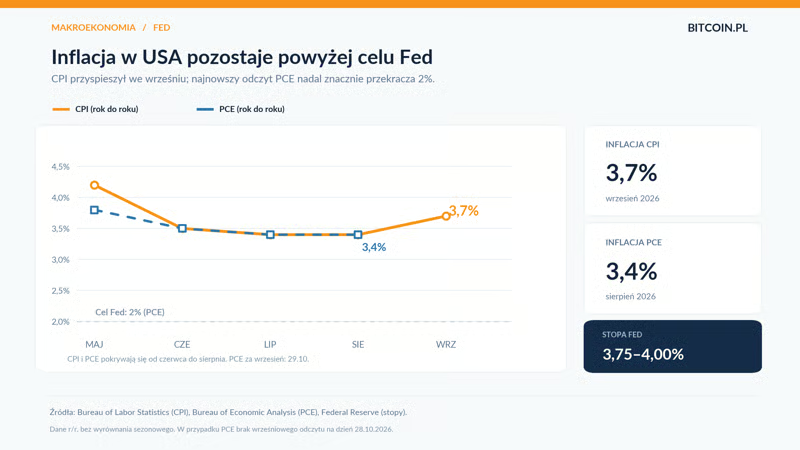
The latest data do not justify declaring victory over inflation. According to a report by the US Bureau of Labor Statistics (BLS), consumer prices increased by 3.7% year on yearcompared to 3.4% in August. The monthly CPI dynamics amounted to 0.6%. Much of the increase was caused by fuel prices: gasoline prices increased by 9.1% during the month. Core inflation, excluding food and energy, was 2.6% annualized.
The picture is similar for the Fed’s preferred measure of PCE inflation. Data from the Bureau of Economic Analysis (BEA) show that in August this indicator increased by 3.4% year on year, and its base version by 3.0%. Both readings clearly exceed the central bank’s 2 percent target. September PCE data are scheduled to be published on October 29, i.e. after the FOMC meeting.
The energy market remains an additional source of uncertainty. The increase in oil prices and transport costs may be transmitted to the prices of other goods and services. The Fed cannot increase the supply of raw materials, but it can reduce demand through more expensive credit. The problem is that too aggressive tightening of monetary policy risks weakening the economy and employment.
Strong economy and weaker employment. Tough choice for Warsh
The American labor market sends mixed signals. In September, there was only an increase in non-agricultural sectors 29 thousand jobsand the unemployment rate was 4.2%as confirmed by the BLS report. A slight increase in employment suggests caution, but unemployment remains relatively low and consumption and business investment support economic activity.
The change in Fed language is significant. In its September statement, the bank described the economy’s growth rate as “solid”, while in October it used the stronger term “strong”. This is not a commitment to another rate hike, but a signal that the FOMC currently sees no serious signs of a decline in economic activity.
Before the meeting, the bond market had already partially tightened financing conditions. According to Reuters, the yield on 10-year US Treasury securities exceeded 5% on Wednesday morning, and the DXY dollar index was near 102.4 points. High yields increase the cost of credit and compete for capital with stocks and other risky assets. They may also limit the need for rapid rate increases by the Fed itself.
Bitcoin close to 81 thousand USD. Why does the Fed’s decision matter for cryptocurrencies?
Before the publication of the decision, Bitcoin was trading at around 80-81 thousand USDand Ethereum cost approximately 2.3–2.4 thousand USDaccording to Decrypt Market Review. These are pre-announcement levels, not the confirmed reaction to its announcement.
Bitcoin has a limited supply and is not directly subject to Fed monetary policy, but its valuation remains dependent on global risk appetite. Higher interest rates make bonds and monetary instruments more attractive. However, a stronger dollar may limit the tendency of some investors to increase their exposure to BTC. On the other hand, stabilization of profitability and the prospect of an end to price increases may improve conditions for digital assets.
However, there is no simple rule according to which a Fed pause always means an increase in Bitcoin and a hike will always mean a decrease. The market often takes into account the expected decision in advance. Capital flows to American spot ETFs, the condition of the stock market, liquidity and the level of debt of investors using derivative instruments are also important. Therefore, the next weeks of quotations may be determined by the tone of the Fed’s communication and new economic data, rather than the lack of an October increase.
December is more important than October
The mentioned Reuters poll indicated that economists expected another rate increase in December. However, this is not a foregone decision: the Fed will be able to assess the next data on inflation and employment. The next major test will come on October 29, with the release of the September PCE and the preliminary estimate of US GDP for the third quarter.
The next FOMC meeting will be December 8-9. Then, new economic forecasts and expectations of Fed members regarding the future level of interest rates will also be presented. Unless inflation begins to decelerate significantly, the arguments for further policy tightening will remain strong. For Bitcoin, this means the next weeks in which macroeconomic data and the bond market may be as important as news from the cryptocurrency industry itself.