
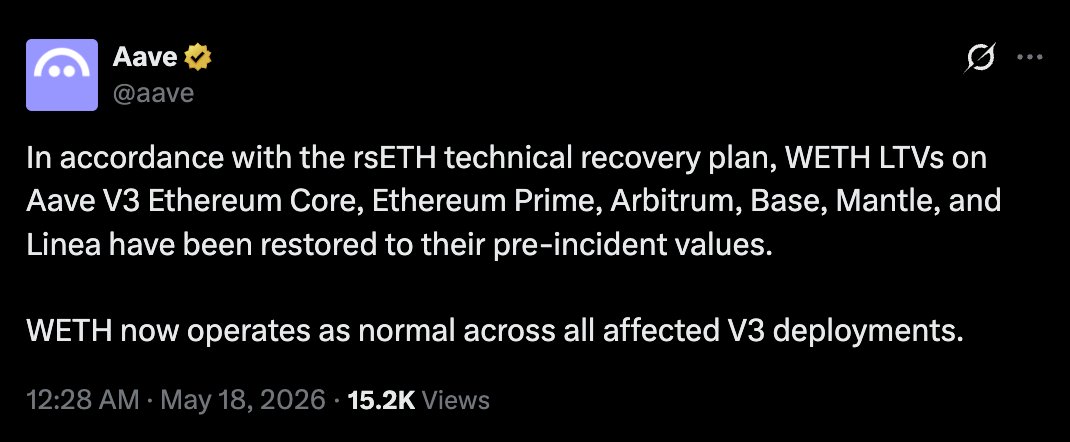
- The Aave protocol has restored standard LTV rates for wrapped ether of 80% to 84% across six V3 networks.
- The decision ends the blockade period introduced after the April attack on rsETH, where the attackers issued uncovered tokens worth $292 million.
- Over 95% of the illegally created rsETH tokens have already been recovered, which allowed for minimizing the systemic risk for the market.
The emergency lockout was a direct result of a configuration error in the LayerZero bridge associated with the rsETH token from the Kelp DAO. Cybercriminals used this vulnerability to generate 112,103 rsETH without any capital, which was approximately USD 292 million at that time. Using these artificial assets as collateral, the perpetrators managed to siphon nearly $230 million in pure ether from Aave’s liquidity pool. the developers’ reaction was immediate. The LTV ratio for WETH was cut to zero, which completely froze the possibility of incurring new liabilities against this token.
Aave Updates rsETH Recovery Plan, Restores WETH LTVs to Pre-Incident Levels Aave has restored WETH loan-to-value (LTV) ratios across affected networks, allowing users to once again borrow against WETH, including through collateral and debt swap functions. Aave founder Stani

How did the crisis affect the Aave ecosystem
The decision to cut off lending opportunities for WETH hit the very liquidity backbone of decentralized finance. Wrapped ether is a fundamental security asset, massively used by traders to build leveraged positions and by liquidity providers.
The abrupt shutdown of this feature trapped millions of dollars in smart contracts and drastically reduced the capital efficiency of the entire DeFi sector. For several weeks, markets had to operate in a mode of limited confidence, waiting for the results of the rescue operation.
Do you currently have cryptocurrencies?
It’s about cryptocurrencies on an exchange, in an application or in a wallet. Don’t treat cryptocurrency ETFs, ETNs and ETPs as ownership.
The survey is anonymous and voluntary. We do not collect your name or IP address. We only publish data in aggregate. Privacy Policy
Accurate recovery parameters on Aave V3
The process of regaining stability was based on mass liquidations and coordinated recovery actions on the secondary market. By mid-May, 106,993 pieces of illegal token were secured. Of this pool, 89,567 rsETH were recovered directly through Aave’s liquidation mechanisms, while another 17,426 pieces passed through the Compound protocol system.
The current shortfall is exactly around 5,200 rsETH. This loss has been pledged to be covered by the industry coalition DeFi United, which ultimately removes the financial burden from existing users.
Official protocol management documents confirm that LTV parameters have returned to the following values:
- Ethereum Core – 80.5%
- Ethereum Prime – 84%
- Arbitrum – 80%
- Base – 80%
- Mantle – 80.5%
- Linea – 80%
A quick return to these metrics shows that the risk management structure was able to absorb the massive shock without bankrupting the protocol.

What the return of Aave security means for the market
The signal sent by Aave restores balance in layer two ecosystems. Investors again gained tools for effective capital management, which immediately translated into an increase in loan volumes.
However, this chapter has not yet been fully closed. In the background, legal disputes regarding funds frozen during the crisis are still ongoing. The issue of ultimate civil liability for the LayerZero bridge configuration error remains open, and lawyers representing the injured funds are analyzing the structure of the code in order to identify those responsible for negligence.
QUIZ FOR THE FIRST TIME
210 questions, 21 seconds each
From 10,000 BTC pizza to the secrets of cryptography. Test your knowledge about Bitcoin and crypto. The record is 23 hits in a row – can you break it?