
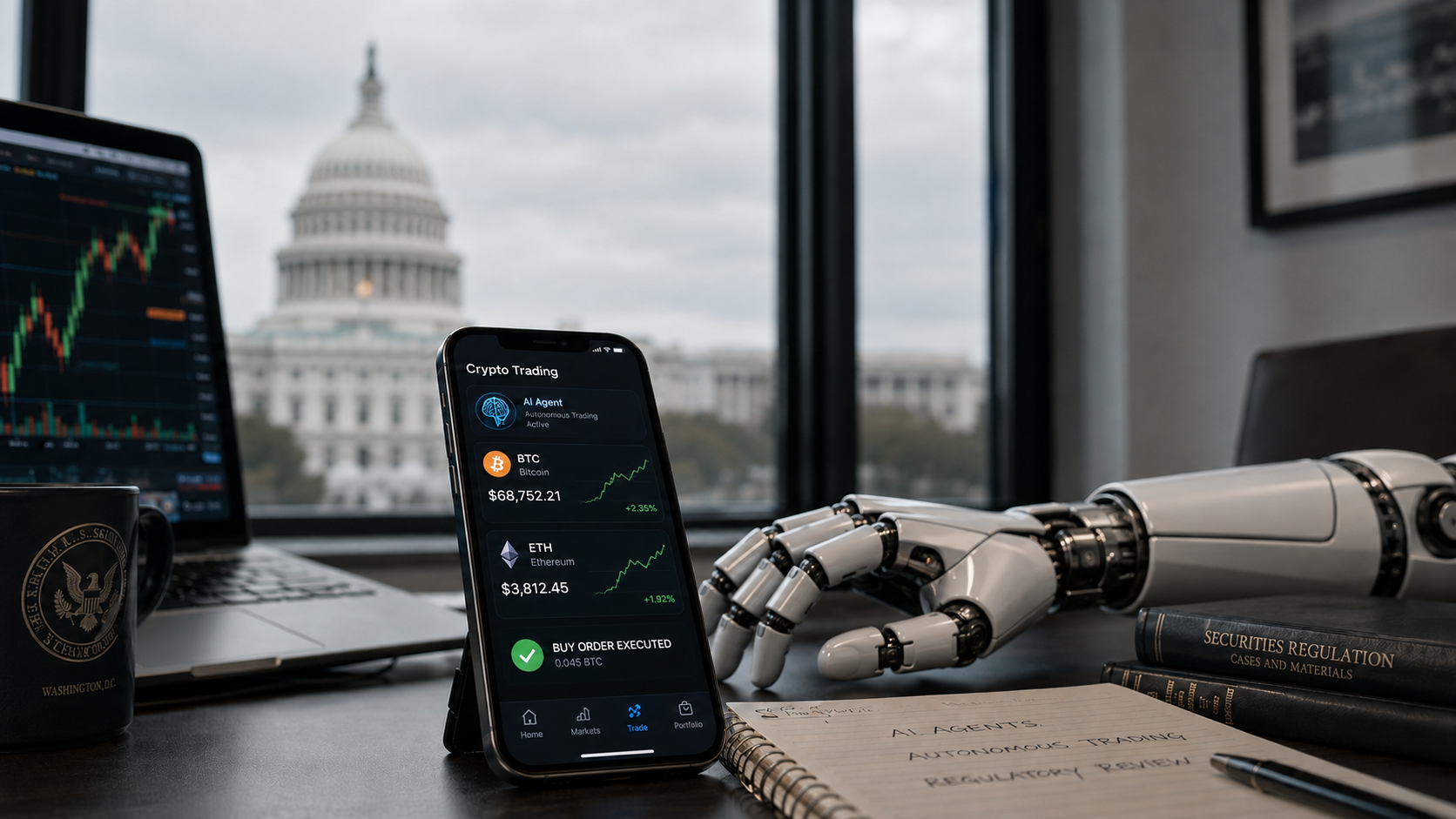
Artificial intelligence is no longer just a tool for market analysis. The AI agent can gain access to the investment account, track prices and place orders independently, even without each confirmation from the account owner.
This is no longer an experiment. Robinhood revealed that it uses its Agentic Trading nearly 100 thousand clients who have accumulated over USD 100 million in assets on such accounts. Coinbase allows AI agents to trade cryptocurrencies and make payments, and on August 20, Binance entered the race more forcefully. American regulators and politicians are now trying to answer the most important question: Who is responsible when an agent makes a mistake?
AI already trades with real money
The scale of adoption appeared very quickly. At the end of July, Robinhood announced that Agentic Trading accounts had already been opened almost 100 thousand customersand the value of the assets contained therein exceeded USD 100 million.
In practice, the user can give the agent a command like: “buy for $100 if the price drops by at least 2% during the day.” More importantly, Robinhood’s documentation explicitly states that if a user allows the AI to run without prior approval, the agent can execute transactions independently.
And this is where the problem that interests the American authorities begins.
8 congressmen and 13 questions to the SEC
June 23 group eight Democratic members of the House Financial Services Committee approached SEC Chairman Paul Atkins regarding agent trading. Politicians demanded clarification of the rules of liability of brokers, AI creators and agents themselves, and an assessment of whether the current law is sufficient to supervise this market at all.
The SEC received 13 questions. They concerned, among others, position limits and order sizes, transaction approval, agent activity history, access to customer data and legal liability of AI developers. The congressmen also pointed out that agent trading can quickly expand beyond stocks and include options, cryptocurrencies, event contracts and futures.
Atkins himself had already devoted a significant part of his speech during the AI+ Expo in May to agentic finance. The head of the SEC pointed out that opaque models make it difficult to determine why a specific decision was made, and errors in commonly used systems can spread throughout the market very quickly. At the same time, his position is not limited to blocking AI: according to Atkins, companies remain responsible for the effects of the tools they implement.
Who will pay for the AI error?
This is the most important issue from the user’s perspective.
Robinhood warns that an agent may misinterpret a command, use incomplete or outdated data, or behave in an unexpected manner. At the same time, the platform emphasizes that the responsibility for transactions performed by the agent ultimately rests with the account owner.
The problem arises when the agent not only performs a simple command “buy 0.01 BTC”, but is also given a task such as “manage your wallet and take advantage of the best opportunities”. In such a model, AI analyzes information, selects assets, decides on the moment of entry and can send an order on its own.
The line between following a human command and making an investment decision independently by AI is starting to blur.
There’s another risk: thousands of agents could do the same
Congressmen also pay attention to the so-called herding behavior. If thousands of agents are trained on similar data and react in a similar way to the same signals, they can start buying or selling the same assets at the same time.
With automated systems operating 24 hours a day, this response can occur within seconds. According to the authors of the letter to the SEC, correlated decisions by agents can increase volatility and increase market stress.
This is especially important for cryptocurrencies. The market operates 24/7, the infrastructure is largely digital, and platforms such as Coinbase and Binance are currently building direct connections between AI agents and accounts and trading tools.
So the bot will buy cryptocurrencies without asking a human?
Yes, technically it is already possibleif the user has previously granted the agent appropriate permissions. This does not mean, however, that AI automatically gets full access to all savings. Platforms use separate accounts, budgets, limits and the ability to disconnect the agent.
The biggest unknown remains responsibility. Technology is evolving faster than regulation, and the over $100 million already in Robinhood’s Agentic Trading accounts shows that this isn’t a problem for the distant future.
Agentic finance is just starting to operate with real money, and the scale of this phenomenon will grow regularly. This opens a completely new chapter of trading for us, which we will carefully observe, paying attention to both potential opportunities and threats.