
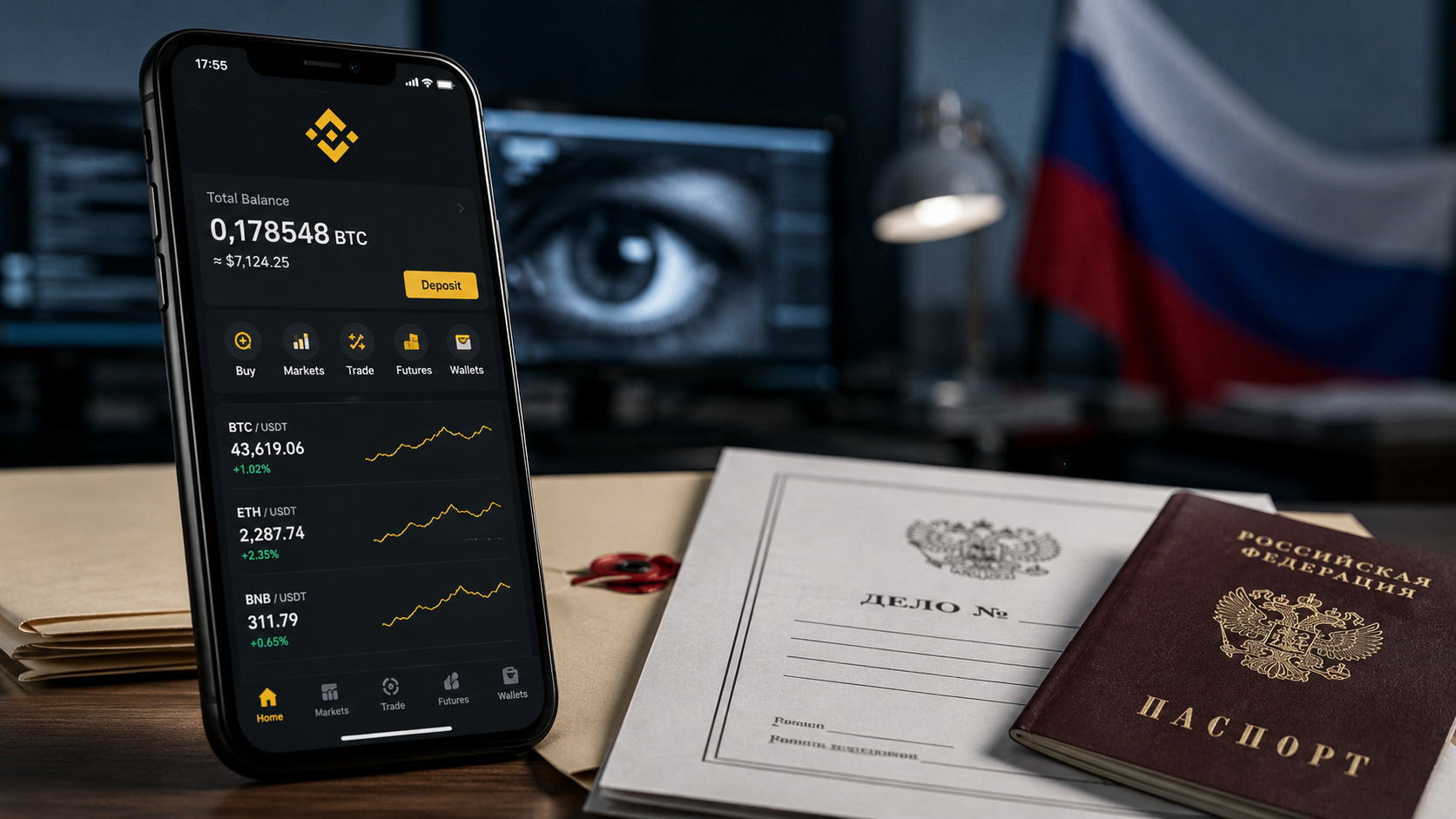
Binance provided Russian investigators with the data of a user who sent cryptocurrencies to organizations supporting Ukraine. The information provided included transaction history, address, telephone number, passport details, and even a copy of the document confirming the right of residence in the European Union. The man is currently in a Russian prison and awaiting trial in a terrorism financing case.
Binance not only provided Russia with transaction history
Belenkiy is a Russian IT specialist with a Russian passport and a residence permit in Bulgaria. According to the Russian Investigative Committee, between January 2023 and March 2024, he allegedly transferred over $700 in cryptocurrencies to the Ukrainian military and an organization associated with it.
Russia considers one of the organizations to which the funds were to go as a terrorist. On this basis, Belenkiy was accused of financing terrorism. He was detained in September 2025 and is currently in Russian custody awaiting trial.
The information package included:
- date of birth,
- address,
- phone number,
- passport number,
- a copy of your Russian passport,
- a copy of the Bulgarian residence permit,
- cryptocurrency transaction history.
The documents show that the Binance data was later entered into evidence in the proceedings against Belenkiy.
The Russians also asked about other users
The matter may have a broader dimension. One of the documents obtained by Reuters indicates that Russian investigators also asked Binance about revealing the identity of other people sending cryptocurrencies to one of the examined wallets.
However, it is not known whether the exchange provided such data or whether other Binance users were included in the investigation. Reuters was unable to determine this, so at this stage there is no basis to claim that Binance provided Russia with information about a larger group of people.
However, the very fact that such a request appears shows how easily public blockchain transaction history can be linked to a user’s identity if at some point he or she used a centralized exchange requiring KYC verification.
Binance came out of Russia, after all
In September 2023, Binance announced the sale of its entire Russian business to the CommEX exchange. At that time, the company explained that its operations in Russia were not consistent with its compliance strategy. Binance declared a full exit from the local market, without participation in future revenues and without the right to repurchase the business.
Despite this, Russian law enforcement was later able to request user information from Binance and receive a response. Binance does not deny that it cooperated with investigators.
The exchange told Reuters that, like other global financial institutions, it responds to lawful requests from law enforcement agencies, taking into account applicable law and privacy regulations. The company also emphasizes that it is not the stock exchange that creates regulations, makes allegations or decides how countries use the information received.
Binance also maintains a special system that allows state authorities and services to submit requests for information.
Could Binance have violated GDPR?
This is one of the most interesting threads of the whole case. Belenkiy has a residence permit in Bulgaria, so if his Binance account was registered as a European Union resident, the way his data was transferred to Russia could raise questions about compliance with European data protection law.
Mike Bystrov, a lawyer specializing in cryptocurrency market regulations, told Reuters that in such a situation the user could have been protected under GDPR. He also drew attention to specific restrictions on data transfers to Russia.
However, this does not mean that Binance has violated GDPR. It is not even known whether Belenkiy was registered on Binance as a user living in Bulgaria, and Reuters was unable to confirm this. The European Data Protection Board declined to comment on a specific case, pointing out that enforcement is the responsibility of the competent authorities of individual countries.
So for now we have a serious legal question, not a confirmed GDPR violation.
Cryptocurrencies are pseudonymous. Stock exchanges no longer exist
For the average Bitcoin holder, this story has one more meaning. The transaction recorded in the public blockchain does not contain the name, surname or passport number. You can see addresses, amounts and the history of funds flow.
However, the situation changes when the address is linked to an account on a centralized exchange. Binance and other regulated platforms collect information as part of KYC procedures so that a specific address or transaction can be linked to a real person in certain cases.
Therefore, calling Bitcoin “anonymous money” is an oversimplification. Blockchain is public, the exchange knows the user, and combining these two sets of information can allow for the reconstruction of a significant part of his financial activity.
The Belenkiya case shows that this is not just a theoretical possibility used in fraud, ransomware or money laundering investigations. In certain jurisdictions, this data may also be available to you very specific political and legal consequences.
Self-custody only solves part of the problem
A natural reaction might be to say, “that’s why you should keep Bitcoin in your own wallet.” This is true, but only partially.
Self-custody means that the user himself controls the private keys and no exchange can unilaterally block his BTC contained in his own wallet. However, it does not delete the history of previous transactions.
If we bought BTC on an exchange that has our KYC data and then withdrawn it to our own address, there is a point that could potentially link our identity with on-chain activity. This is one of the most important differences between control over your own funds and financial privacy. These two concepts are often confused with each other.
This story should also be of interest to users in Poland
The Belenkiya case does not mean that Polish stock exchange users should be afraid that their data will be automatically transferred to any country that requests it. However, it shows something more important.
By using a centralized exchange, we entrust it not only with cryptocurrencies or the ability to buy them, but also with a very accurate record of our financial identity. KYC data, wallet addresses and the public blockchain together create a set of information whose consequences can be much greater than in the case of a simple leak of an email address or phone number.
In the world of cryptocurrencies, we often repeat a rule “Not your keys, not your coins”. The story revealed by Reuters reminds us that in the era of increasingly complex KYC, it is worth asking one more question:
who has your data and who can they share it with?