
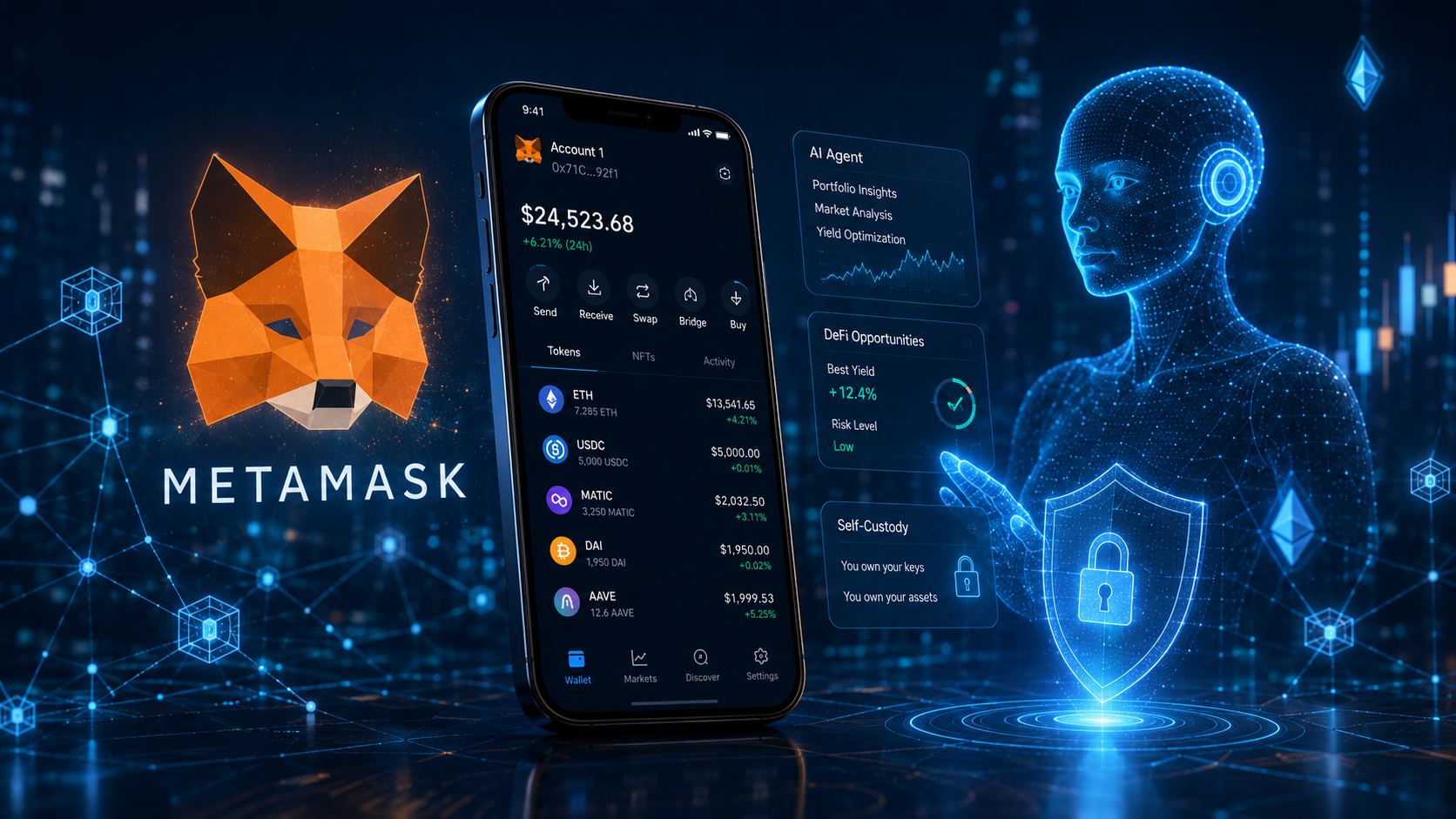
MetaMask opens a new chapter in the world of cryptocurrencies. Agent Wallet allows you to connect an AI agent that can independently execute transactions, trade on the DeFi market and react to the changing situation. The user still controls the keys and sets boundaries. Sounds comfortable. At the same time, it means that for the first time we can easily let artificial intelligence handle real money.
Until recently, an “AI agent trading cryptocurrencies” most often meant its own bot, a few APIs and a lot of code. MetaMask wants to greatly simplify this model.
This is an important change compared to June. When MetaMask launched Agent Wallet on June 8, 2026, access was limited to a small group of Early Access testers. Currently, the official product website leads directly to instructions for installing and configuring the wallet.
You can tell the AI: find an opportunity and execute the trade
The most interesting thing is not just creating another cryptocurrency wallet. It’s about what can be connected on the other side.
The user can commission the agent to perform a specific task, and the agent will prepare and carry out the appropriate blockchain operation. MetaMask supports, among others, swaps, bridges, perpetual contract trading, liquidity provision, lending and borrowing via Aave, and strategies using yield vaults. The documentation also provides for integration with prediction markets.
In practice, you can build an agent to which we issue instructions such as:
“If ETH drops by 5%, convert 500 USDC to ETH.”
Or a much more complex strategy using market data, several protocols and additional AI models.
This is where Agent Wallet starts to get really interesting. It is not just an interface that facilitates the signing of transactions. It is intended to be a layer between artificial intelligence and real capital located on the blockchain.
But do we really want to give AI access to money?
This is also the biggest problem of the entire concept.
A classic cryptocurrency wallet assumes that the decision is made by a human. Even if a user clicks on a bad link or signs an unsafe transaction, he or she ultimately takes the final step.
The agent works differently.
It can analyze dozens of sources, respond 24/7 and perform operations without asking the owner for permission each time. If such a system makes a mistake, is manipulated by prompt injection, or starts acting in a way that the user did not expect, the consequence does not have to be a wrong answer in the chat. The consequence may be the loss of cryptocurrencies.
MetaMask itself indicates prompt injection, key exposure and too broad permissions as characteristic threats related to agent-operated wallets. For this reason, the agent is not treated as a trusted owner of funds, but as software proposing transactions within previously established rules.
Guard Mode or Beast Mode
MetaMask’s answer to this problem is two modes of operation.
Default Guard Mode allows you to define daily withdrawal limits and a list of protocols that the agent can use. When it tries to perform an operation outside the established rules, the transaction stops and requires additional user consent.
Confirmation can be done, among others: via the MetaMask Mobile application or a link sent by e-mail.
The second option is Beast Modeintended primarily for more advanced users. The agent receives more freedom here and can use any protocols. However, the layer that checks transactions for threats still works. Operations deemed malicious should not be performed automatically and are submitted for manual approval.
The names are marketing, but the problem behind them is very real: how much independence can you give to a program before automation becomes more of a threat than a help?
Agent Wallet has an additional layer of security before executing a transaction.
MetaMask simulates operations to detect errors and unexpected state changes, among other things. The next element is threat scanning using Blockaid technology. In addition, there are Smart Transactions, whose task is, among other things, to reduce problems related to MEV.
MetaMask also declares Transaction Protection covering eligible operations deemed safe by the system. The maximum declared protection is PLN 10,000. USD per month, with additional conditions and eligibility criteria applicable.
These are important safeguards, but should not be confused with a guarantee that the AI agent will not lose money.
The security system can detect a malicious contract. However, he does not have to know that the investment strategy chosen by the agent is terrible.
If AI legally opens a position with high leverage and then it is liquidated moments later, no amount of phishing or malicious smart contract protection will solve the problem.
The keys don’t go into the AI model
MetaMask emphasizes that Agent Wallet remains a self-custodial solution.
In server wallet mode, keys are secured in the TEE environment, and the agent receives a dedicated wallet instead of direct access to the user’s main wallet. There is also Bring Your Own Wallet mode, in which the keys remain locally on the user’s side.
This is a very important distinction.
The agent can be able to manage capital without having to provide the AI model with a seed phrase or private key. It is the permissions and security layer of the wallet that decides what the agent can do on its own.
AI is starting to get its own money
Agent Wallet is part of a much larger trend.
For the past two years, the tech industry has focused primarily on what AI models can say, write or generate. The next stage is systems that can perform actions independently.
Buy services. Use the API. Deal. Manage capital.
Blockchain fits this model almost perfectly. The agent does not need a bank account, payment card or traditional identity. All you need is a wallet and appropriate permissions.
Therefore, the combination of AI and cryptocurrencies may turn out to be much more important than another wave of tokens with the note “AI” in the name.
If autonomous systems do become one of the main ways of using the Internet, they will need their own financial infrastructure. Wallets like Agent Wallet are an attempt to build it now.
The most interesting test is yet to come
Technically, the ability to create a cryptocurrency trading agent is not a revolution. Trading bots have been around for years.
Something else changes: the entry threshold.
Instead of writing the entire environment from scratch, you can connect a popular AI agent to a ready-made wallet, give it specific permissions and start automating your DeFi activities.
This could open up a whole new market of tools, strategies and services built around autonomous agents.
At the same time, a new security rule appears before users. So far we have repeated: don’t entrust your keys to anyone.
Now you will need to add the second one:
if you give AI access to money, be very specific about what it is actually allowed to do with it.
It is also worth remembering that the availability of specific services depends on the country and regulations. For example, some features related to predictive markets are restricted in certain jurisdictions. MetaMask lists Poland among the regions where trading on Polymarket via the Predictions feature in the MetaMask app is unavailable.