
Key takeaways:
- The Polish system of benefits, reliefs and subsidies is scattered among many institutions. Citizens often have to know where to look, when to submit an application and what conditions to meet.
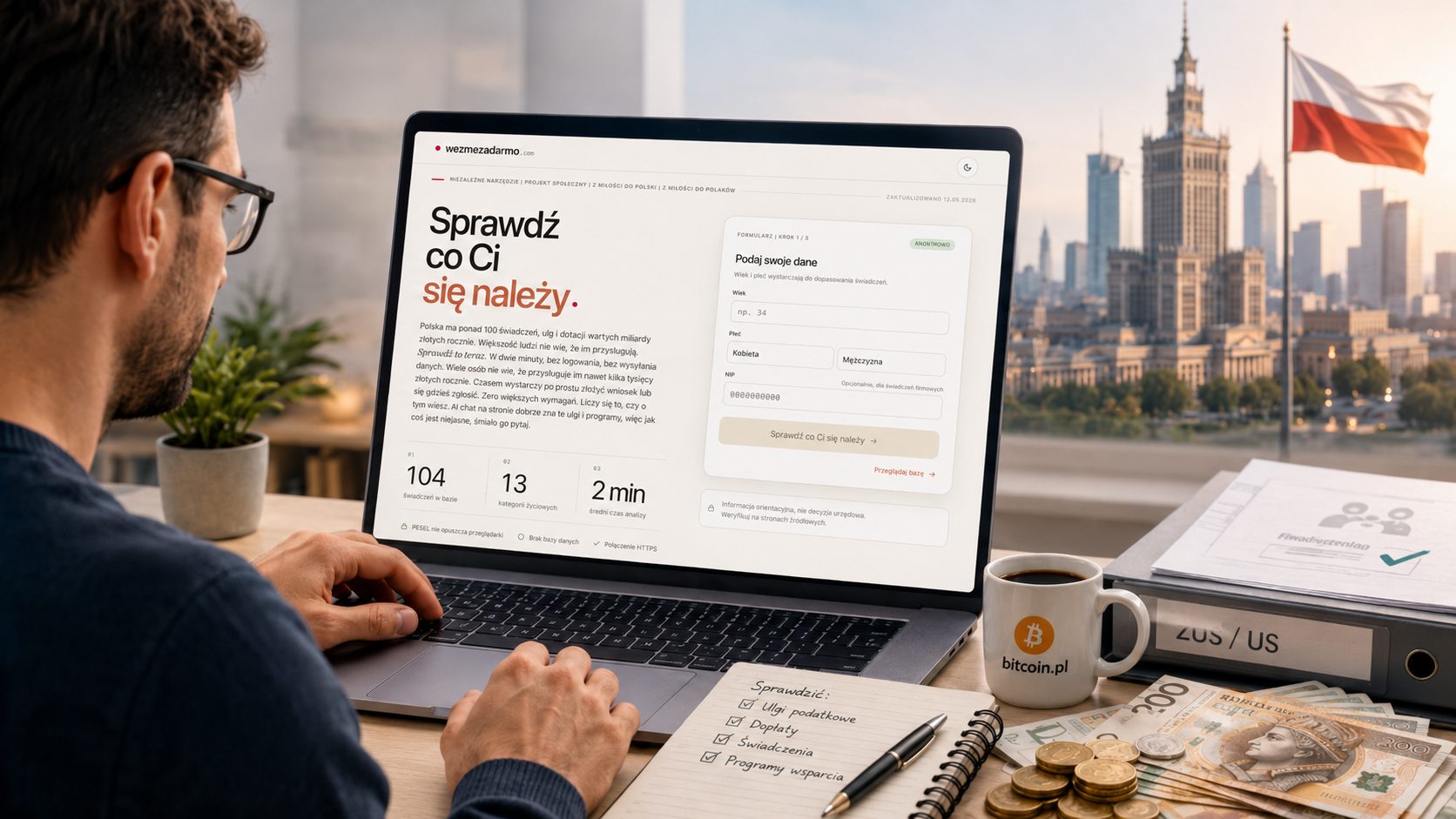
- Wezmezadarmo.com is trying to solve this problem with a simple AI tool that, without registration, checks what benefits a given person may be entitled to, and then translates the rules in simple language.
On the project website we read that the database includes 104 benefits in 13 categories, and the tool works without logging in and without sending sensitive data such as PESEL outside the user’s browser. The website itself describes itself as an independent tool and social project. At the same time, he emphasizes that the result is indicative and the decision is always made by the appropriate institution.
The problem is not a lack of programs. The problem lies in access to knowledge
Poland has an extensive system of benefits, reliefs and subsidies. Families can benefit from, among others, the Family 800 plus program, in which from January 1, 2024, the benefit amounts to PLN 800 per month for a child up to the age of 18. Applications are processed by ZUS, and for the period 2026/2027 they can be submitted electronically from February 1, 2026.
This is just one example. The Ministry of Family also offers the Active Parent program for parents of children aged 12 to 35 months, Good Start, the Large Family Card, family benefits, the maintenance fund and other forms of support.
Tax reliefs are a separate category. At kontakt.gov.pl you can find, among others, child relief, thermal modernization relief, rehabilitation relief, internet relief, relief for young people, relief for working seniors, relief for families 4+ and return relief.
PFRON programs are available for people with disabilities, including “Active self-government”. In 2026, applications in selected areas can be submitted electronically in the SOW system, and recruitment dates vary depending on the module and type of support.
And this is where the problem begins. A citizen does not just need a list of programs. I need an answer to a simple question: “Does this apply to me?”
How does Wezmezadarmo.com work?
The mechanism is simple. The user provides basic information about his/her life situation, such as age, gender, family, housing and professional situation, status as a student, retiree, unemployed person, farmer or entrepreneur. According to the website’s privacy policy, PESEL, if used, is to be processed only locally in the browser, and demographic and situational data are processed only for the time of analysis and are not stored on the server.
Then, the system matches the user’s profile to benefits, discounts and subsidies. The result does not replace the office’s decision, but it may indicate where it is worth looking, what application to submit and which institution to contact.
In practice, this may mean that the parent will check not only 800 plus, but also other family programs. A low-income student will see potential scholarships or educational support. A person running a business can find information about contribution preferences, reliefs or programs for entrepreneurs more quickly. Seniors can check benefits, discounts and care programs.
AI as a translator between the citizen and the office
The most interesting element of the project is not the benefits base itself. Such a database can be built in a spreadsheet. The challenge comes when you need to understand the terms.
Official descriptions are often formal, full of references to statutes, income thresholds, exceptions and deadlines. For a person who does not work with law, taxes or ZUS on a daily basis, such language can be a barrier. AI can help where a list of links alone is not enough.
The website assistant is supposed to respond contextually. This means that the user can click on a specific benefit and ask what a given condition means, what documents to prepare, when to submit an application or where to start. This is a practical application of AI that does not try to replace public institutions, but can help citizens find the right information.
A good example are cases handled by ZUS. The PUE/eZUS platform allows you to submit applications, transfer documents, check data collected in ZUS and receive answers electronically. For many people, the mere information that a given matter can be dealt with online shortens the path from “I don’t know where to start” to “I can submit an application”.
An independent tool, but not an official decision
When it comes to public benefits, the devil is in the details. What matters are dates, income, family composition, insurance status, form of employment, judgments, place of residence and current regulations. Even unemployment benefits depend on meeting specific conditions, including the period of work in the last 18 months and registration at the employment office.
Why such projects can make sense
In the discussion about artificial intelligence, language models, company valuations, chips, data centers and office automation often receive the most attention. This is an important piece of the market, but not the only one.
If a tool can indicate possible benefits, reliefs or subsidies in a few minutes, its value does not result from the technological “wow” effect. It results from a simple fact: thanks to it, someone can submit an application that they would not have submitted before.