
Key takeaways:
- Owners of photovoltaic (PV) farms, hotels, energy storage facilities and large commercial facilities are increasingly looking for a way not to sell surplus energy at low or negative prices.
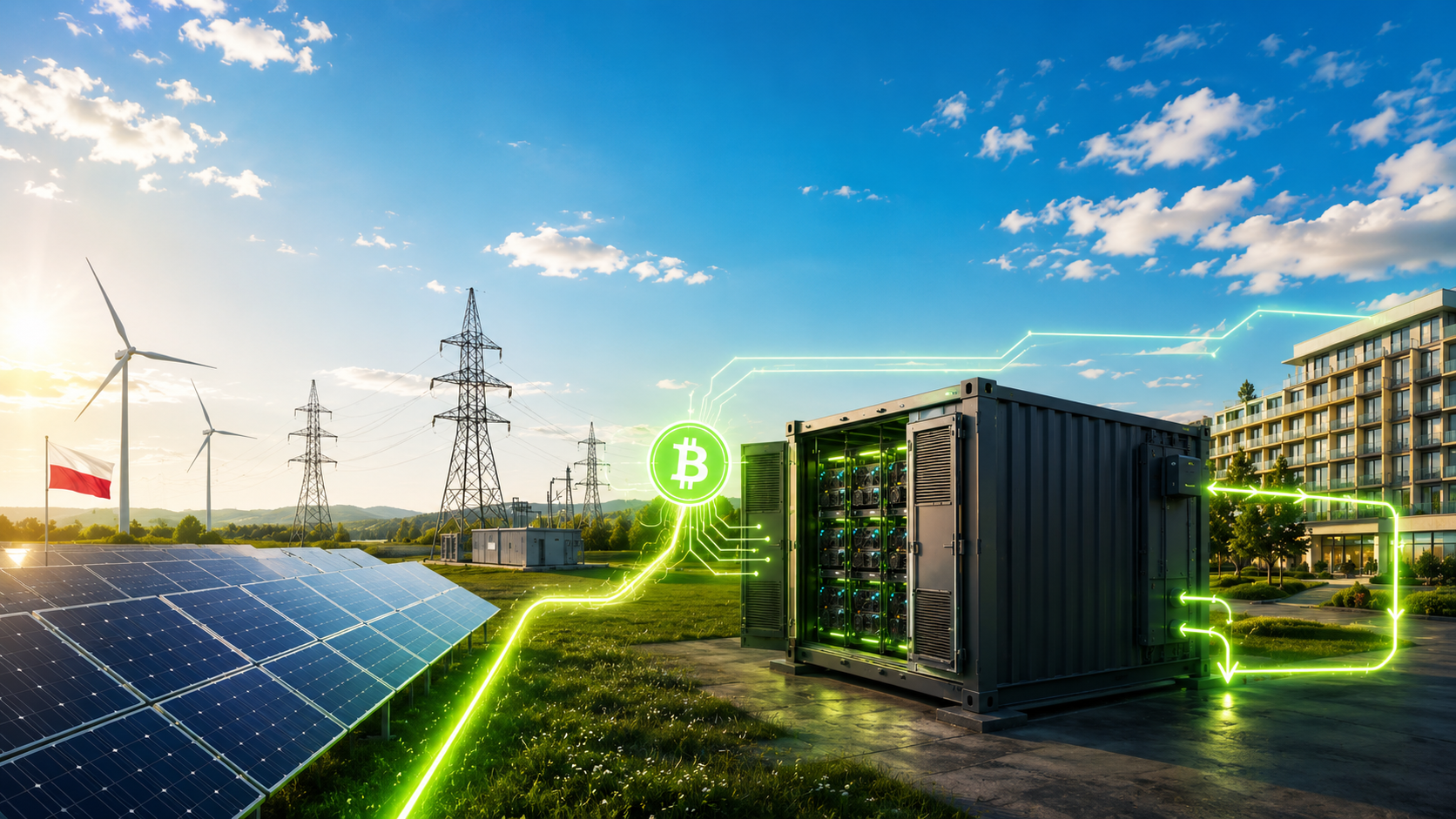
- SolHash uses mining infrastructure as a flexible power receiver that can work when energy has the lowest market value and at the same time generate additional value for the owner of the installation.
- This model does not eliminate the risks related to the cryptocurrency market, energy prices and equipment costs, but for some renewable energy owners it may become a way to improve the economics of the entire investment.
Energy production alone is no longer enough
Just a few years ago, conversations about photovoltaics looked very similar. The larger the installation, the greater the success. The more energy produced, the greater the income. Most investors focused on one goal: produce as much as possible and feed energy into the grid.
This model worked well for a while. However, the market has changed.
Today, the owner of a renewable energy installation increasingly often has to answer a more difficult question: what to do with the energy when the grid does not need it, prices are falling, and sales are no longer profitable?
This is no longer classic thinking about mining. This is a model in which energy does not have to be sold at any price. It can be used locally, in a way that gives the installation owner an additional option to monetize the same asset.
Why do renewable energy owners need new solutions?
Polish photovoltaics was developing very quickly. The installed capacity of PV has already exceeded 24 GW, and on sunny days, the production of energy from renewable energy sources can heavily load the system. The problem is that the electricity grid is not growing at the same pace as the number of installations.
The effect is visible on the market. Hours with very low or even negative energy prices are becoming more and more common. This is a real problem for the owner of a PV installation. It produces a lot of energy exactly when the market pays the least for it.
This changes the meaning of the entire investment. In such an environment, the advantage begins not with those who simply produce the most energy, but with those who can manage it best.
PLN 469/MWh or PLN 2,892/MWh? Numbers that matter
Let’s imagine the owner of a PV farm with a capacity of 1 MW. Such an installation can produce approximately 1,000 MWh of energy per year. If the average value of energy sales is approximately PLN 469/MWh, the annual gross revenue from energy sales alone may amount to approximately PLN 469,000. zloty.
At first glance it looks good. The problem begins when some of this energy enters the market at hours when its price is low, zero or negative.
This is where SolHash shows you an alternative. According to the SolHash calculator, 1 MWh of energy used in an appropriate mining model may correspond to a value of up to approximately PLN 2,892. This comparison does not mean that every megawatt hour will always generate this result. The cryptocurrency market is volatile, mining difficulty varies and the result depends on hardware, cost and configuration.
But the difference itself shows something very important: energy can have a completely different value depending on how it is used.
For the owner of renewable energy, this is a fundamental change. Instead of passively accepting the market price, he can actively manage where his energy goes. SolHash gives him a tool for this.
SolHash does not sell “cryptocurrency mining”. It sells better energy use
The biggest mistake in assessing this type of solutions is that many people still look at mining through the prism of stereotypes. Noisy devices, garages, random installations, high temperatures and chaotic operation.
The SolHash model is about something different.
Mining becomes a controlled energy receiver. It can be launched when the energy has a low market value. It may be limited when it is more profitable to sell energy to the grid. It can also work with energy storage, EMS systems and local consumption in the facility.
This is especially important for owners of PV farms, hotels, production plants, logistics centers, farms and other facilities that have their own energy sources. In their case, energy does not have to be only a cost or a product sold to the grid. It can become an asset that is managed in real time.
“SolHash helps with this transition: from a simple “I produce and sell” model to “I produce, analyze, optimize and choose the best scenario.”
Are you interested in implementing a similar solution? Contact us (customers recommended by us can choose a 10% discount on services or an additional year of warranty).
Additional value: heat from mining infrastructure
There is one more element in mining that is increasingly interesting to facility owners. It’s warm.
Computing devices consume energy, perform work, and generate heat. In a poorly designed model, heat is the problem. In a well-designed system, it can become a resource.
In practice, this means that mining infrastructure can not only generate digital assets (cryptocurrencies), but also support the heating of domestic water, selected rooms or other elements of the building’s infrastructure. This is particularly interesting in hotels, recreational facilities, production plants and places that use a lot of heat all year round.
The energy owner gains greater independence
In the traditional model, the owner of the PV installation depends on the price offered by the market. It produces energy and must sell it under certain conditions. If the price is low, revenue decreases. If negative prices occur, the economics of investing become even more difficult.
SolHash adds a new layer to this model. The energy owner can use his own production to create digital assets. He doesn’t have to buy them on the stock exchange. It does not have to start with a classic investment exposure. He can use the energy he already has.
This is important, especially after the problems of many centralized cryptocurrency platforms in recent years. The slogan “not your keys, not your coins” has become a reminder to the market that independent control over assets is important.
In the SolHash model, the owner of the installation can combine his own energy, his own infrastructure and his own digital assets. For some investors, it is not only a matter of profit, but also of greater control over what they produce and how they use it.
Who might find SolHash particularly interesting?
SolHash may be a particularly interesting solution for owners of photovoltaic farms who see a decrease in the profitability of selling energy at certain hours. It may also be of interest to hotels, large commercial facilities, industrial plants, energy storage operators and investors who want to increase auto consumption.
Such a model makes the most sense where there is a surplus of energy, where there is a possibility of technical integration of the system and where the owner understands that the energy and cryptocurrency markets require ongoing analysis.
This is not a solution for everyone. And that’s why SolHash’s advantage is not the infrastructure itself, but its approach to optimization. The company does not only sell devices. It helps to look at energy as an asset that can be used in several different models.
Risks still exist
A stronger economy does not mean there is no risk. Mining depends on the BTC rate, mining difficulty, energy cost, equipment efficiency, service costs, tax conditions and regulations. Equipment may be aging. Profitability may vary. The result from the calculator is not a guarantee of future income.
This is why SolHash should be treated as an energy flexibility tool, not a magic constant profit machine. A well-implemented system can improve the economics of renewable energy installations, but requires analysis, proper configuration and a realistic approach to market volatility.
SolHash shows where the renewable energy market is heading
The energy market is entering a stage where production alone is no longer a sufficient advantage. Flexibility is becoming more and more important. Plant owners need to know when to sell energy, when to store it, when to use it locally, and when to redirect it to other processes.
SolHash fits exactly in this direction. It gives owners of renewable energy sources an additional tool for working with surplus energy. It helps turn the problem of low energy prices into a potential source of additional income. It also shows that mining can be part of the modern energy industry, and not just a separate segment of the cryptocurrency market.
The text is informative and promotional in nature. It does not constitute investment, energy or tax advice or a recommendation to purchase mining equipment or cryptocurrencies. The results presented by the SolHash calculator are estimates and depend on many variables, including energy prices, cryptocurrency exchange rates, mining difficulties, costs of equipment, service, taxes, regulations and technical conditions of a specific installation. Before making an investment decision, you should conduct your own analysis and consult appropriate specialists.