
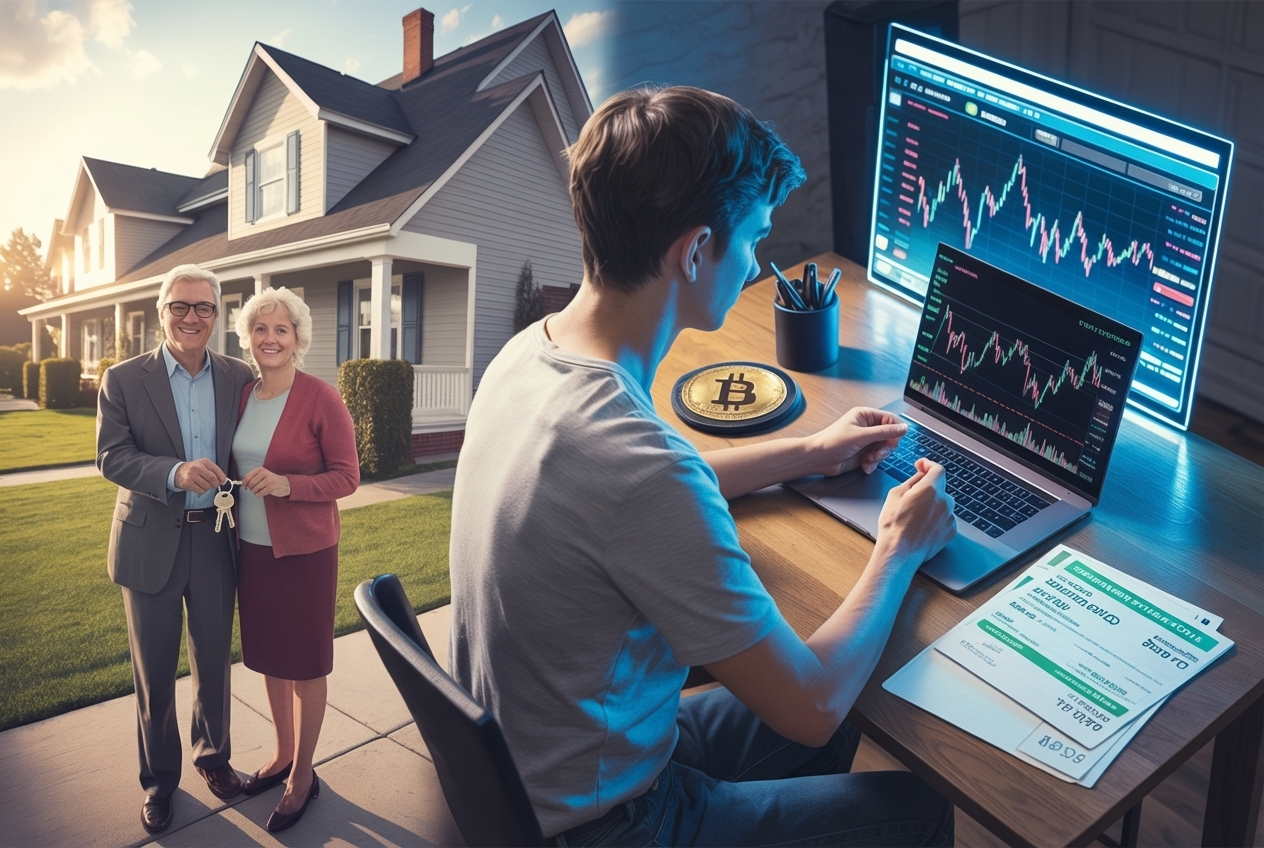
Why do millennials and Gen Z prefer to spend their money on Bitcoin instead of patiently saving for their own m4? Because the rules of the game have completely changed in the real estate market.
Polish real estate market: a dead end with an entry price
In Poland, the median price of a square meter in Warsaw has already exceeded PLN 18,000. In Kraków, Gdańsk and Wrocław the situation is not much better. With the average net salary oscillating around PLN 5,000-6,000 per month, purchasing a 50-square-meter apartment means spending the equivalent of over 12-15 annual gross salaries.
Today it is 7.5x globally, and in Polish metropolises we are easily breaking these records. An own contribution of 20% for an apartment worth PLN 700,000 is PLN 140,000. By saving PLN 1,500 a month – which, given the current cost of living, borders on financial athleticism – you collect this amount for almost 8 years. However, during this time, real estate prices rise faster than your deposit grows. A treadmill that keeps accelerating despite your best efforts.
When the traditional path deviates to the path of Bitcoin
This is where the interesting part begins – the one that economists talk about in silence and the financial media wraps it in moralizing.
If you invest PLN 1,500 per month for 10 years with 7% growth per year, you are building real capital. But if you direct the same money towards a down payment for a property whose price increases faster than your savings – you are not building anything. Low volatility, negative expected value.
And this is where Bitcoin comes in all gold and orange.
Not as digital gold, not as an ideological response to the system. As a mathematically correct answer to incorrectly priced risk. An instrument with extreme volatility and positive expected value for someone who has been effectively price excluded from the “safe” path of building wealth.
In the US, the median age of first-time homebuyers has increased from 29 to 40. In Poland, similar data are equally brutal. An entire generation that was supposed to build wealth through real estate is spending its “accumulation years” on the rental market – financing the wealth of apartment owners, not their own.
What’s more, many people are in such a bad situation that banks refuse a loan due to their calculated creditworthiness, even though these people often pay more per month for rent than they would pay in loan installments.
In this context, aggressive exposure to Bitcoin, prediction markets or other high-volatility instruments ceases to be a gamble. It becomes the only available leverage for people without starting capital inherited from the previous generation.
Unfortunately, there are many people who cannot count on inheritance, property or help from their parents. Therefore, Bitcoin appears to be one of the most effective ways to accelerate the building of your capital and financial cushion, since apartments have become a luxury good.
Will Bitcoin replace real estate?
Not in the literal sense – no one will live in a hardware wallet. But as a vehicle for building capital for the generation pushed out of the real estate market, it now serves the function that cheap mortgage loans and rising housing prices did for the boomers.
There is one difference: that path was planned by the system. The current one – because of the algorithm and steadfastness. The question is, does that make her less rational? Mathematics says no, and rising prices per square meter prove that investing in Bitcoin is the future.